


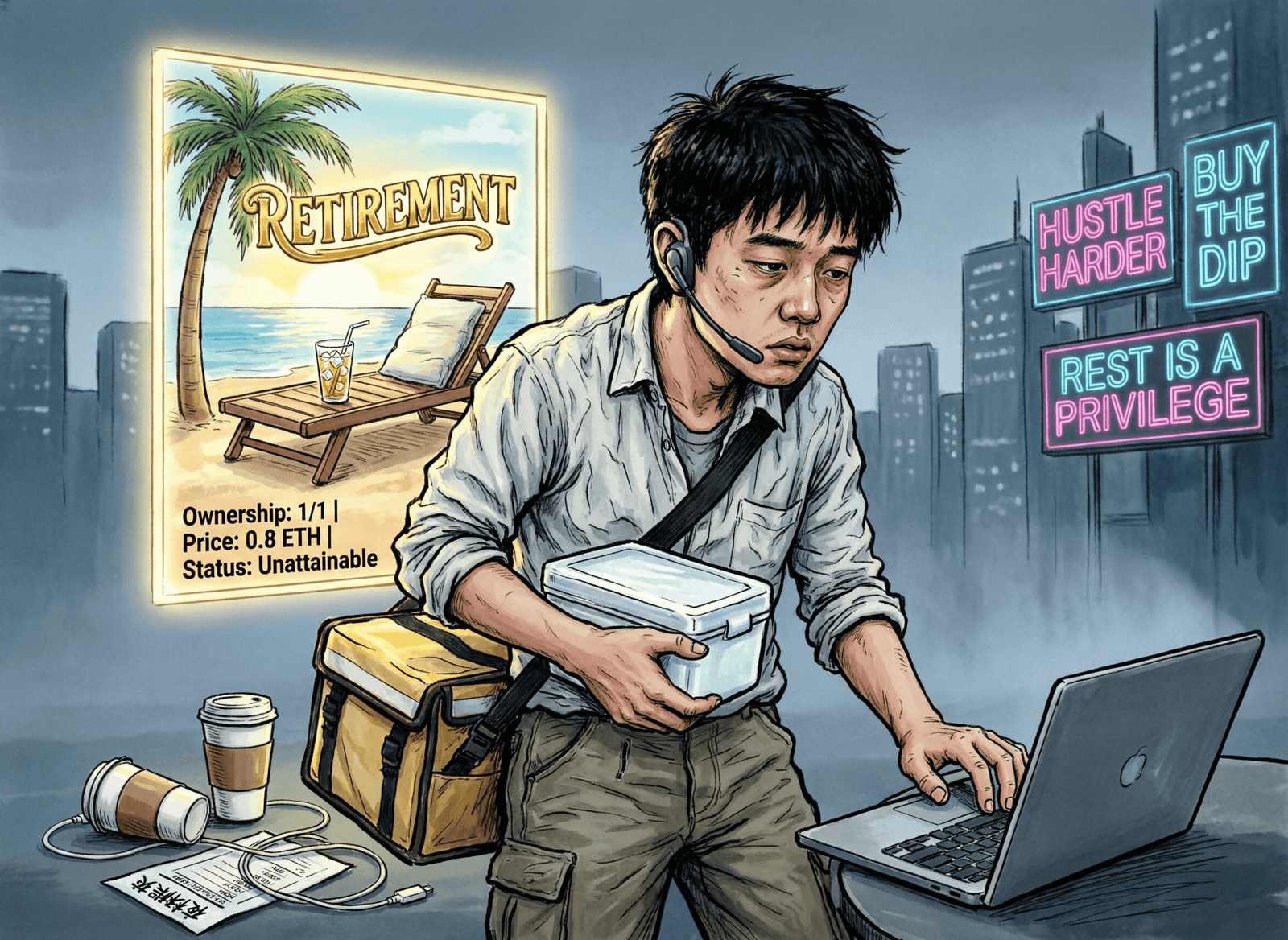
Your golden years just became a digital collectible.
Wall Street has launched “Retirement NFTs”—limited-edition tokens that represent “ownership” of a peaceful future: beach sunsets, slow mornings, and the mythical state of “not working.” For $499, you can buy “Retirement Dream: Age 65 (Beach Edition).” The catch? You’ll likely never live to cash it in. But hey—you own the idea.
This isn’t investing. It’s the final monetization of deferred hope.
The Myth of Owned Serenity
The pitch is deceptively poetic: “You may not retire. But you can still claim the dream.”
Promotional videos show serene avatars walking on empty shores, captioned: “Your future self thanks you.”
But buyers admit the hollowness.
“I bought the ‘Mountain Cabin’ NFT. My therapist said it’s ‘grief for a life I was promised.’ I framed it anyway.” — @FutureSelfScammed
“My Retirement NFT says ‘Valid after 40 years of work.’ I’m 32. I have three jobs. Math says I die at 78. So… 2 years of rest?” — @TokenizedTired
So much for security.
Ultimately, this isn’t about planning—it’s about selling the illusion of an exit strategy in a game with no exits.
The Mechanics of Deferred Hope
After purchasing the “Beach Edition,” we uncovered the fine print:
- NFT Tiers:
- Basic ($499): “Retirement Lite” – 2 weeks/year of imagined peace
- Premium ($1,999): “Full Exit” – includes digital deed to a non-existent cottage
- Legacy ($4,999): “Generational Rest” – pass your dream to children who’ll also never use it
- Redemption Clause: “Retirement activated only upon proof of sustained income, health insurance, and emotional readiness (rarely granted).”
- Secondary Market: Trade your NFT when hope fades. Current floor price: 0.03 ETH (down 89% from launch).
Worse: some employers now offer Retirement NFTs as “benefits” instead of pensions. One HR memo reads: “We can’t give you security. But we can give you the aesthetic of it.”
The Merchandising of Impossible Futures
And yes—there’s merch:
- “I Own Retirement (In Theory)” T-shirt
- “Certified Future Retiree (Pending)” enamel pin
- A $30 “Retirement Simulation Kit” (includes a seashell, a sunrise alarm clock, and a note: “Close your eyes. Pretend.”)
Of course, the ecosystem expands:
- “Hope Staking”: Lock your NFT to earn “peace points” redeemable for meditation apps.
- “Death Insurance”: Ensures your NFT transfers to heirs before you collapse from exhaustion.
- “Legacy of Rest” DAO: A community that votes monthly on which retirement fantasy feels most plausible.
Your right to rest? Now a speculative asset.
You’re not tired—you’re under-tokenized.
The Bigger Picture: When Rest Becomes a Luxury NFT
This didn’t emerge in a vacuum.
It’s the logical endpoint of a system that treats security as privilege and generational betrayal as innovation.
As we explored in American Youth: Too Busy Being Young to Reach ‘Adult Milestones’, young adults are already told they’re “failing” for lacking homes, marriages, or careers. Now, even their retirement is reduced to a JPEG they can’t afford to live.
High-authority sources confirm the drift:
- Economic Policy Institute: 57% of Americans have less than $1,000 saved for retirement.
- Pew Research: 64% of Gen Z believes they’ll “never fully retire.”
- Brookings Institution: The wealth gap between generations is the widest in U.S. history.
The real cost? Not the $499.
It’s the commodification of basic human dignity—where rest becomes a luxury you can own, but never experience.
The Hidden Irony: Who Profits From Your Exhaustion?
Let’s be clear: Wall Street doesn’t care if you retire.
It cares if you keep buying dreams.
By selling you retirement as an NFT, it ensures you’ll keep working—to pay for the fantasy of stopping.
One former fintech strategist admitted anonymously: “We don’t sell retirement. We sell the feeling that it’s still possible—if you just buy one more token.”
And it works.
Over 200,000 Retirement NFTs sold in Q1 2026. Not because people believe they’ll use them—but because hope is the last asset they can still afford to lose.
Conclusion: The Cynical Verdict
So go ahead. Buy the NFT.
Frame your beach sunset.
Stare at it during your third shift.
But don’t call it planning.
Call it grief with better graphics.
And tomorrow? You’ll probably scroll past another ad for “Retirement: Alpine Edition”…
knowing full well your only mountain is the pile of unpaid bills on your desk.
After all—in 2026, the most valuable thing you’ll ever own isn’t your future. It’s the proof that someone sold it to you.
