


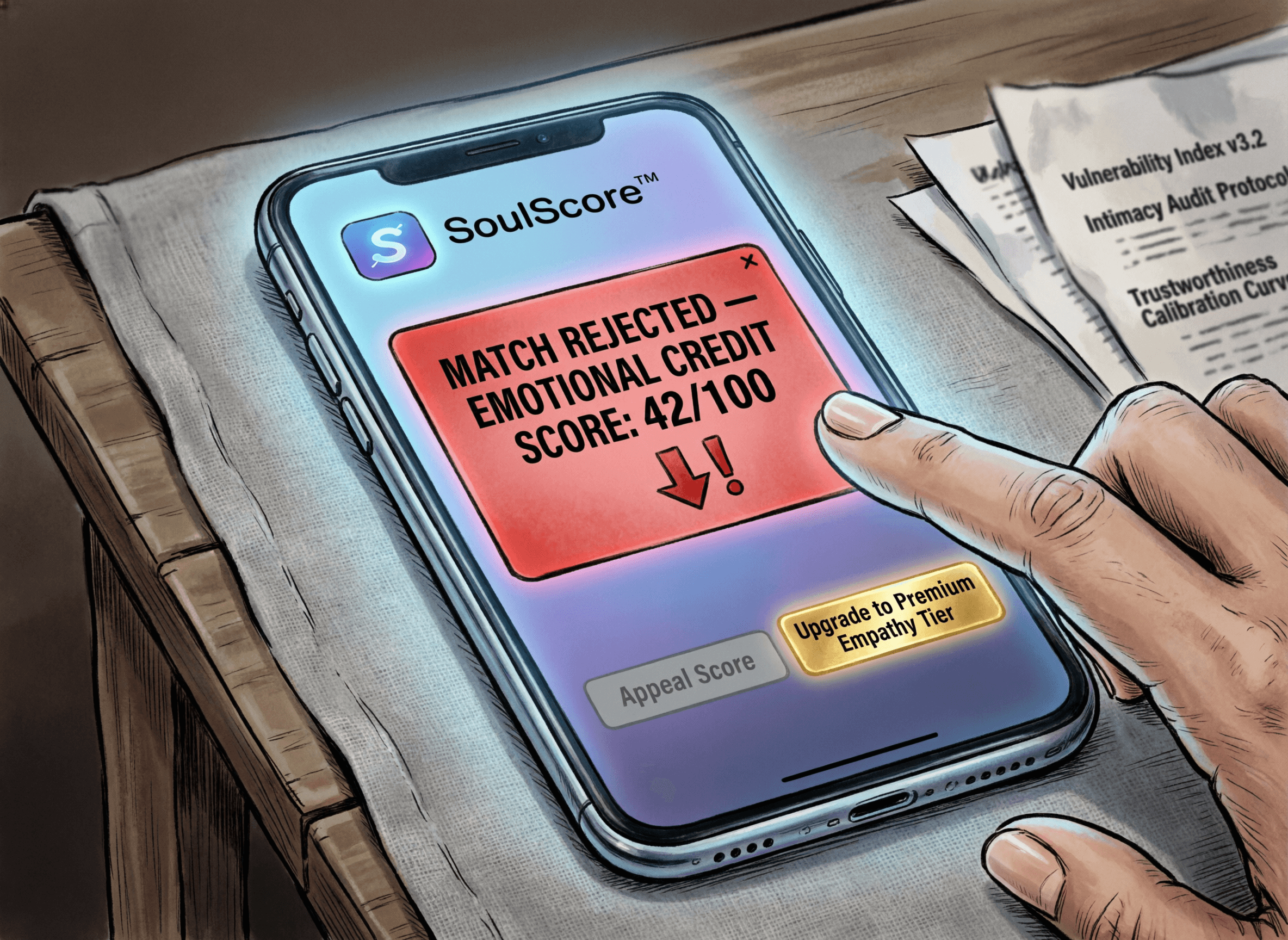
Your capacity to love just got a FICO rating.
Major dating apps—Hinge, Bumble, and even Tinder—have quietly integrated “Emotional Credit Scores” into their matching algorithms. Developed by wellness-tech firm **HeartMetrics™**, the score rates users on “vulnerability reliability,” “conflict resolution history,” and “attachment stability.” Too volatile? Your profile gets shadowbanned. Too avoidant? You’re labeled “high-risk.” As one app tooltip reads: “Love is blind. But we’re not.”
This isn’t romance. It’s the final audit of intimacy.
The Myth of Data-Driven Love
The pitch is deceptively scientific: “Why gamble on feelings when data can protect your heart?”
Promotional materials show couples smiling over coffee, captioned: “Matched at 780 Emotional Credit. Still thriving.”
But users report emotional gatekeeping.
“My score is 620 because I cried during a breakup last year. The app says I’m ‘emotionally uninvestable.’ So I guess my grief disqualified me from love.” — @HeartDenied
“I matched with someone amazing. Then the app flagged us: ‘Combined Emotional Risk: High.’ We never got to say hello.” — @PreemptivelySingle
So much for serendipity.
Ultimately, this isn’t about compatibility—it’s about turning human messiness into a risk portfolio.
The Mechanics of Relational Scoring
After linking our accounts to HeartMetrics, we uncovered the criteria:
- Data Sources:
- Therapy app usage (“consistent journaling = +20 pts”)
- Text sentiment analysis (“excessive exclamation points = emotional instability”)
- Social media tone (“posts about loneliness = -35 pts”)
- Score Tiers:
- 750+ (“Secure Asset”): Priority matches, “low-drama” badge
- 600–749 (“Growth Potential”): Limited visibility
- <600 (“High-Risk Liability”): Hidden from most users, suggested only to other “high-risk” profiles
- Improvement Plans: Pay $29/month for “Emotional Credit Repair”—AI coaching on “safe vulnerability.”
Worse: some employers now request Emotional Credit Scores during hiring. One HR form asks: “Is your candidate emotionally stable enough to represent our brand in love?”
The Merchandising of Intimacy
And yes—there’s merch:
- “My Emotional Credit Is Higher Than My Self-Worth” T-shirt
- “Certified Low-Drama Partner” enamel pin
- A $35 “Safe Vulnerability Kit” (includes scripted texts like “I feel… cautiously optimistic”)
Of course, the ecosystem expands:
- “Score Boost Coaching”: Learn to “perform secure attachment” even if you’re spiraling.
- “Heartbreak Insurance”: Covers therapy costs if your match ghosts you after seeing your score.
- “Legacy of Love” NFTs: Own a digital certificate of your highest-rated relationship—even if it lasted 3 days.
Your right to be imperfectly human? Now a liability.
You’re not lonely—you’re under-rated.
The Bigger Picture: When Love Becomes a Portfolio
This didn’t emerge in a vacuum.
It’s the logical endpoint of a culture that treats relationships as assets and vulnerability as exposure.
As we explored in American Youth: Too Busy Being Young to Reach ‘Adult Milestones’, young adults are already told they’re “failing” for lacking traditional markers of success. Now, even their capacity to connect is scored like a loan application.
High-authority sources confirm the drift:
- American Psychological Association: Algorithmic matchmaking increases anxiety and reduces authentic connection.
- Pew Research: 61% of daters feel pressure to appear “emotionally stable” online—even when they’re not.
- Nature Human Behaviour: Reducing relationships to metrics erodes empathy and long-term bonding.
The real cost? Not the rejected match.
It’s the commodification of the human heart—where love must be pre-approved to exist.
The Hidden Irony: Who Profits From Your Longing?
Let’s be clear: dating apps don’t care if you find love.
They care if you keep swiping.
By scoring your emotions, they ensure you’ll pay to “fix” yourself—again and again.
One former data scientist admitted anonymously: “We don’t match people. We match risk profiles. And broken hearts renew subscriptions.”
And it works.
Premium sign-ups have surged 45%. Not because people are finding love—but because they’re desperate to prove they’re worthy of it.
Conclusion: The Cynical Verdict
So go ahead. Journal daily.
Text with calibrated warmth.
Optimize your emotional credit.
But don’t call it love.
Call it venture intimacy with better UX.
And tomorrow? You’ll probably draft a message saying “I’m doing great!”…
while wondering if anyone would love you if your score dropped below 600.
After all—in 2026, the most valuable thing you own isn’t your heart. It’s your rating.
