


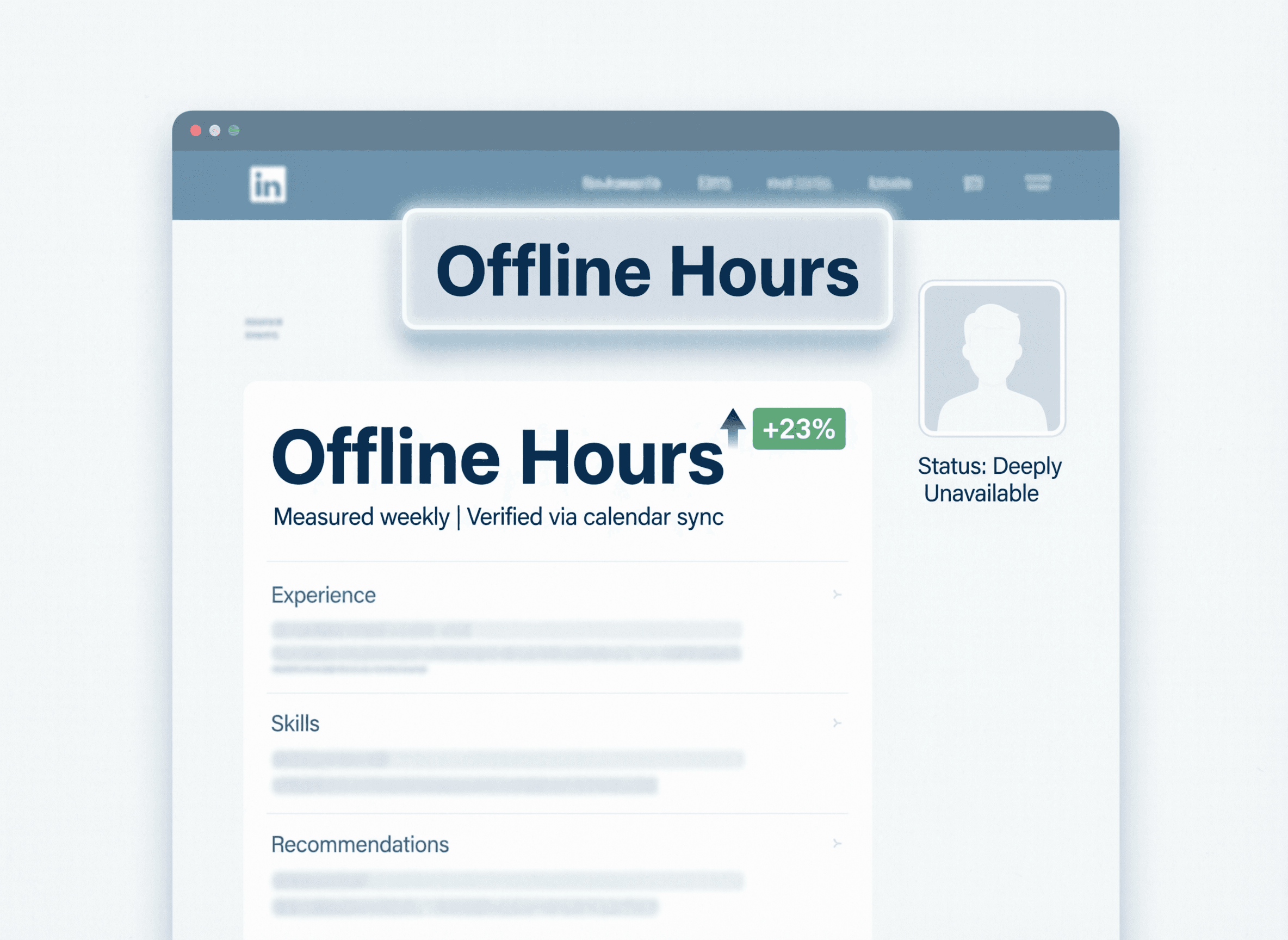
Your silence just became a KPI.
LinkedIn has rolled out “Offline Mastery”—a new profile metric that tracks how many hours per week you spend *not* online, then ranks you as a “mindful leader,” “burnout-resistant innovator,” or “strategically unavailable visionary.” The more you disconnect, the higher your leadership score… as long as you log it first.
This isn’t rest. It’s the final gamification of absence.
The Myth of Productive Disconnection
The pitch is deceptively serene: “Great leaders don’t scroll. They reflect.”
In-app prompts celebrate users who “chose presence over pixels.” One notification reads: “You were offline for 3 hours! Your focus score just increased by 12%.”
But early adopters see the trap.
“I turned off my phone to cry in peace. Forgot to log it. My Offline Score dropped. Now I’m ‘emotionally unoptimized.’” — @QuietlyFailing
“My boss said my ‘Offline Mastery’ makes me ‘promotion-ready.’ I haven’t slept in days. But hey—I look balanced on paper.” — @RestingOnBrand
So much for genuine downtime.
Ultimately, this isn’t about well-being—it’s about turning disconnection into another form of competitive performance.
The Mechanics of Measured Absence
After enabling the feature, we uncovered how it works:
- Tracking Method: Syncs with phone usage stats, calendar gaps, and even smartwatch “stillness” data.
- Scoring Tiers:
- 0–5 hrs/week: “Digitally Overwhelmed” (career risk)
- 6–12 hrs/week: “Mindfully Present” (standard)
- 13+ hrs/week: “Strategic Absentee” (leadership material)
- Verification Requirement: Must manually confirm each offline block—because true rest only counts if reported.
Worse: recruiters now filter candidates by “Offline Mastery.” One job post reads: “Must demonstrate ≥10 hrs/week of intentional disconnection. Burnout is not a strategy.”
The Merchandising of Quiet
And yes—there’s merch:
- “I Was Offline (But I Logged It)” T-shirt
- “Certified Strategically Unavailable” enamel pin
- A $40 “Digital Detox Theater Kit” (includes a journal titled “Thoughts I’ll Post Later” and a phone lockbox)
Of course, the ecosystem expands:
- “Offline Coaching” ($39/month): Learn to “perform stillness” without actually stopping work.
- “Presence Insurance”: Covers accidental screen time during sacred offline blocks.
- “Legacy of Silence” NFTs: Own a timestamped certificate of your longest verified offline streak.
Your right to be alone? Now a resume line.
You’re not resting—you’re building personal brand equity.
The Bigger Picture: When Rest Becomes a Resume Item
This didn’t emerge in a vacuum.
It’s the logical endpoint of a culture that treats every human act as data and silence as strategic.
As we explored in American Youth: Too Busy Being Young to Reach ‘Adult Milestones’, young adults are already told they must “optimize” every aspect of life. Now, even their absence must be quantified to count.
High-authority sources confirm the drift:
- Harvard Business Review: “Digital minimalism” is now a hiring criterion in tech and finance.
- Pew Research: 64% of professionals feel pressure to “perform wellness” online—even when exhausted.
- American Psychological Association: Constant self-monitoring increases anxiety, even during rest.
The real cost? Not the missing badge.
It’s the erasure of unobserved humanity—where only logged silence gets to exist.
The Hidden Irony: Who Profits From Your Quiet?
Let’s be clear: LinkedIn doesn’t care if you rest.
It cares if your rest generates engagement.
By scoring your offline time, it ensures you’ll keep coming back—to prove you were away.
One former product lead admitted anonymously: “We don’t want you offline. We want you to come back and brag about how offline you were.”
And it works.
Since launch, profile views for “Offline Masters” have surged 210%. Not because people are calmer—but because absence, once verified, becomes the ultimate flex.
Conclusion: The Cynical Verdict
So go ahead. Turn off your phone.
Sit in silence.
Then log every minute like it’s a deliverable.
But don’t call it peace.
Call it performance with better lighting.
And tomorrow? You’ll probably post: “Recharged after 14 hrs offline!”…
while wondering if anyone would care if you’d just stayed quiet forever.
After all—in 2026, the most valuable thing you can do isn’t rest. It’s prove you rested better than everyone else.
