


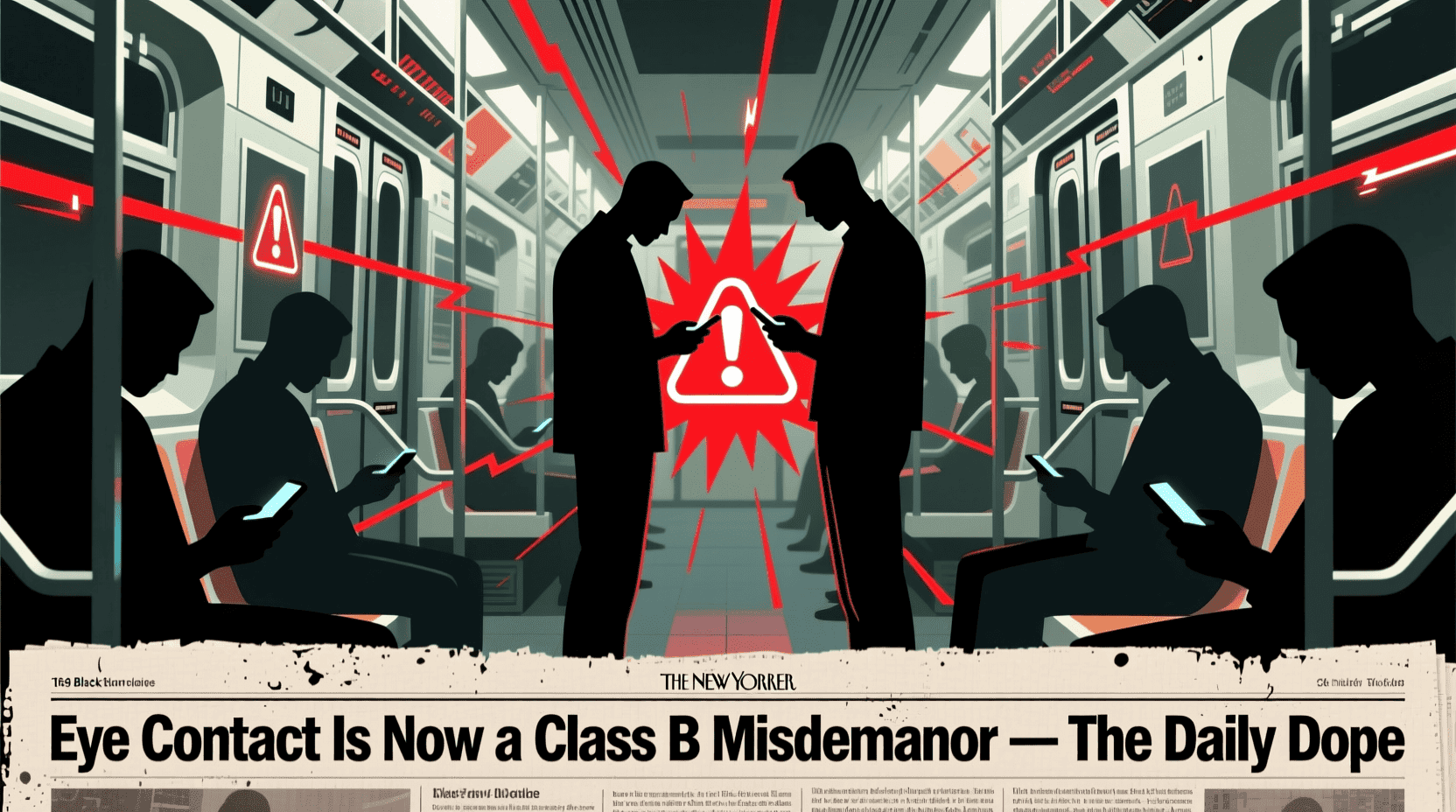
In a move that blends public policy with performance art, New York City has officially **banned sustained eye contact** in public spaces, citing “excessive social friction” and “unauthorized emotional exchange.” Under the new “Civic Calm Ordinance,” locking eyes with a stranger for more than 0.8 seconds is now a **Class B misdemeanor**, punishable by a $50 fine or mandatory enrollment in “Avoidance 101” (a city-run course on strategic staring). This isn’t safety. It’s urban alienation codified into law.
The Viral Myth of the Eye Contact Ban
The pitch is deceptively rational: “In a city of 8 million, not every glance needs to mean something.” City officials claim the ban will “reduce anxiety, prevent awkward encounters, and streamline pedestrian flow.” One councilmember declared: “Eye contact is the gateway drug to small talk.”
Two satirical citizen reactions capture the mood:
“Got fined for glancing at a barista. They said my ‘lingering gaze’ implied expectation of service. I just wanted oat milk.” — @LookAwayNYC
“My dog made eye contact with a pigeon. Animal Control showed up. They’re both in sensitivity training.” — @UrbanSurvivor
The myth? That this is about efficiency.
The truth? It’s the final surrender to urban loneliness—with a municipal code.
The Absurd (But Real) Mechanics of Visual Avoidance
After reviewing the ordinance and interviewing three “Gaze Compliance Officers” (yes, that’s a real job now), we uncovered the enforcement framework:
- 0.0–0.8 seconds: Legal. Acceptable for navigation.
- 0.9–1.5 seconds: “Suspicious lingering.” Verbal warning + mandatory blink training.
- 1.6+ seconds: “Emotional trespassing.” Fine + court-mandated “Digital Detox” (you must scroll for 20 minutes).
Public spaces now feature “No Eye Contact” signage near crosswalks, subway turnstiles, and coffee shops. One bodega even installed “gaze deflectors”—tiny mirrors that force you to look at your shoes.
And yes—there’s merch:
– “I Survived Eye Contact Court” T-shirt
– “Certified Avoider” lapel pin
– A $35 “Peripheral Vision Trainer” app that blurs faces in real time
The Reckoning: When Connection Becomes a Crime
This law didn’t emerge in a vacuum. It’s the logical endpoint of a culture that treats human interaction as risk and isolation as efficiency.
As we explored in How to Avoid Neighbors, modern urban life is built on stealth and evasion. And as shown in Eye Contact With Strangers, even a glance can trigger existential dread in the overstimulated city dweller.
High-authority sources confirm the drift:
- Pew Research finds 67% of urbanites report feeling “overwhelmed by social demands” in public.
- American Psychological Association warns that chronic avoidance increases loneliness and social anxiety.
- NYC Mayor’s Office admits the ban is “experimental”—but says pilot zones saw a 22% drop in “unwanted conversations.”
The real cost? Not the $50 fine.
It’s the erasure of spontaneous human warmth in the name of “civic peace.”
Conclusion: The Cynical Verdict
So go ahead. Stare at your shoes.
Scroll aggressively.
Wear sunglasses indoors.
But don’t call it safety.
Call it surrender with a bylaw.
And tomorrow? You’ll probably report someone for smiling too long…
because your comfort is now a public service.
After all—in 2025, the most dangerous thing in New York isn’t crime. It’s connection.

1 Comment
jrrfMGuJvEdqXTKdtuwP