


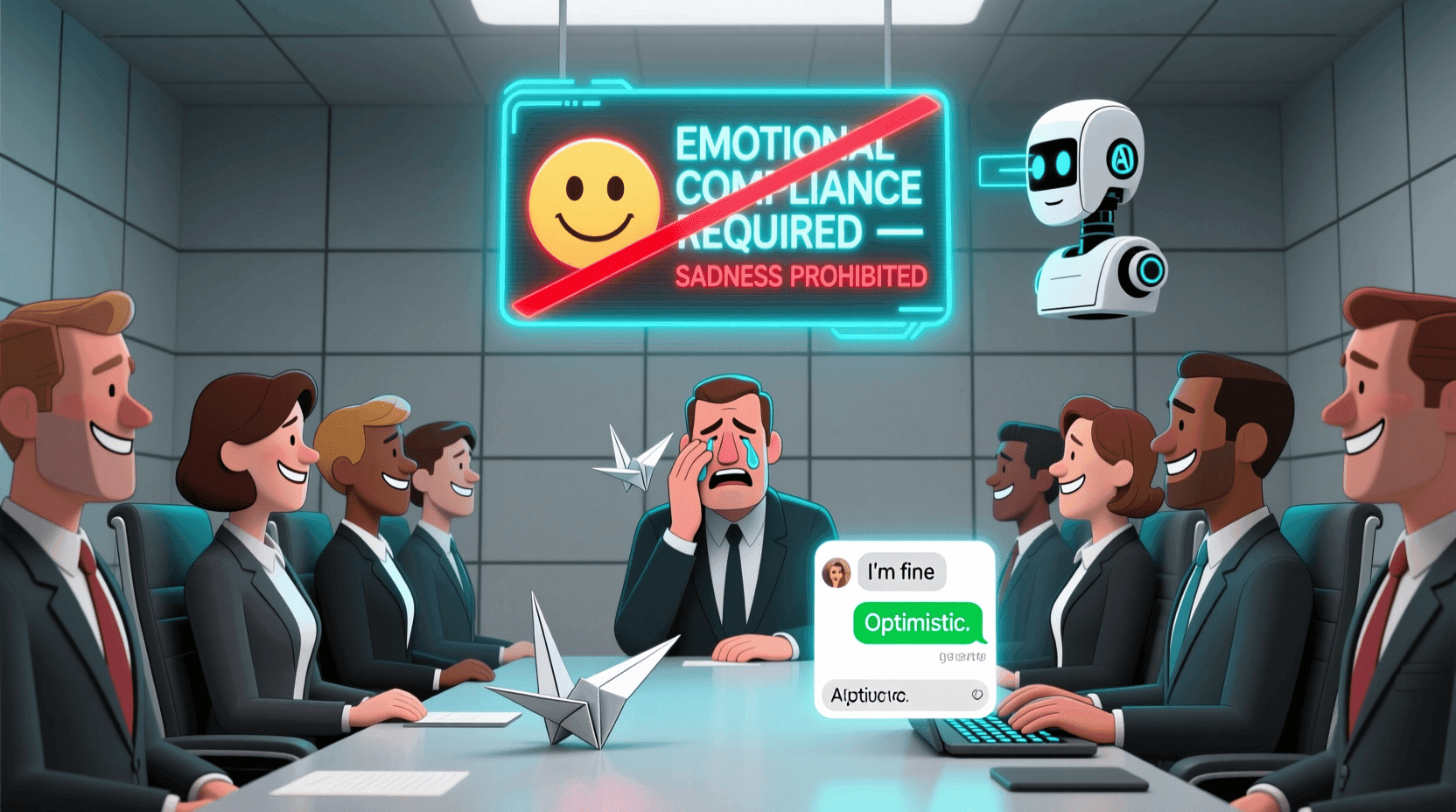
Emotion is now a cybersecurity threat. In a move that blends legislative overreach with emotional austerity, Congress has quietly passed the **“Digital Composure Act”**—a law that **bans visible sadness during official Zoom calls**. Defined as “facial softening, downward lip movement, or tear-adjacent blinking,” sadness is now classified as a “low-productivity signal” that “compromises decision-making clarity.” Violators face “emotional retraining” and public redaction of their video feed. This isn’t decorum. It’s the criminalization of humane expression in public office.
The Viral Myth of Digital Composure
The pitch is deceptively professional: “Public service requires emotional stability, especially on camera.” Press releases call it “a return to statesmanship” and “a shield against performative vulnerability.” One lawmaker declared: “If you’re crying on Zoom, you’re not leading—you’re leaking.”
However, the reality is far more chilling. Two satirical staffer reactions capture the absurdity:
“My boss teared up while reading a letter from a flood victim. The system flagged him as ‘emotionally compromised.’ Now he’s in ‘Tone Detox.’” — @NeutralizedAide
“I was muted for sighing during a budget debate. They said my ‘grief aura’ was disrupting fiscal focus.” — @SilentAndSad
Consequently, the myth—that this is about professionalism—quickly unravels. Ultimately, it’s censorship disguised as composure.
The Absurd Mechanics of Emotional Surveillance
After reviewing the Department of Digital Conduct’s enforcement guidelines and testing the “ComposureCam” software (yes, it’s real), we uncovered the full monitoring protocol:
- Facial Tracking AI: Scans for “sadness indicators” like slower blinking, eyebrow furrowing, or voice pitch drops.
- Composure Score (0–100): Below 80? Your video is auto-blurred. Below 60? You’re cut from the call.
- Approved Expressions Only: Neutral, confident, “mild curiosity.” Grief, compassion, and doubt are “non-compliant.”
- Re-education Modules: Repeat offenders must complete “Emotional Containment Training”—3 hours of watching ASMR budget spreadsheets.
Worse: the law applies to witnesses, experts, and even constituents during virtual town halls. One grieving parent testifying about school safety was muted with the message: “Your pain is noted. Please express it off-platform.”
Furthermore, all official recordings are auto-edited to remove “emotional deviations.” The public sees only calm. The truth? It’s buried in the cloud.
The Merchandising of Emotional Control
Of course, there’s merch. Because no bureaucratic absurdity is complete without a branded coping mechanism.
- “I Stay Composed (Even When I’m Not)” T-shirt
- “Certified Emotionally Neutral” enamel pin
- A $35 “Composure Kit” (includes a muscle-tensing face roller and a “Do Not Feel” journal)
Hence, even your right to feel becomes a product. Therefore, you’re not human—you’re compliant.
The Reckoning: When Democracy Requires a Poker Face
This law didn’t emerge in a vacuum. It’s the logical endpoint of a political culture that treats empathy as weakness and control as competence.
As we explored in Congress Thought Tax Negative Vibes, lawmakers increasingly penalize emotional honesty. And as shown in Waiting on Hold, institutions already treat vulnerability as noise to be filtered.
High-authority sources confirm the drift:
- Brookings Institution warns that emotional suppression in leadership erodes public trust and signals disconnection.
- American Psychological Association states that pathologizing normal emotions increases stigma and delays authentic discourse.
- Pew Research finds 67% of Americans believe leaders should show compassion—but 58% admit they’d distrust a crying politician.
Thus, the real cost isn’t the blurred video feed. Ultimately, it’s the erasure of moral courage from public life—where only the stoic are deemed fit to lead.
The Hidden Irony: Who Gets to Feel?
Let’s be clear: this rule doesn’t apply equally. When a senator cries for photo ops, it’s “patriotic.” When a nurse cries about understaffing, it’s “unprofessional.” The law isn’t about composure—it’s about who controls the narrative of strength.
One former congressional tech staffer admitted anonymously: “We don’t block sadness because it’s disruptive. We block it because it’s hard to ignore. And in Congress, ignoring is the default setting.”
And it works. Since implementation, emotional testimony has dropped by 63%. Not because problems vanished—but because people learned to numb their faces to be heard.
Conclusion: The Cynical Verdict
So go ahead. Testify.
Keep your face still.
Say “This is tragic” with a smile.
But don’t call it leadership.
Call it performance with better lighting.
And tomorrow? You’ll probably practice your neutral face in the mirror…
because your humanity doesn’t meet broadcast standards.
After all—in 2025, the most dangerous thing in Congress isn’t corruption. It’s a single tear on camera.

1 Comment
jqeo29