


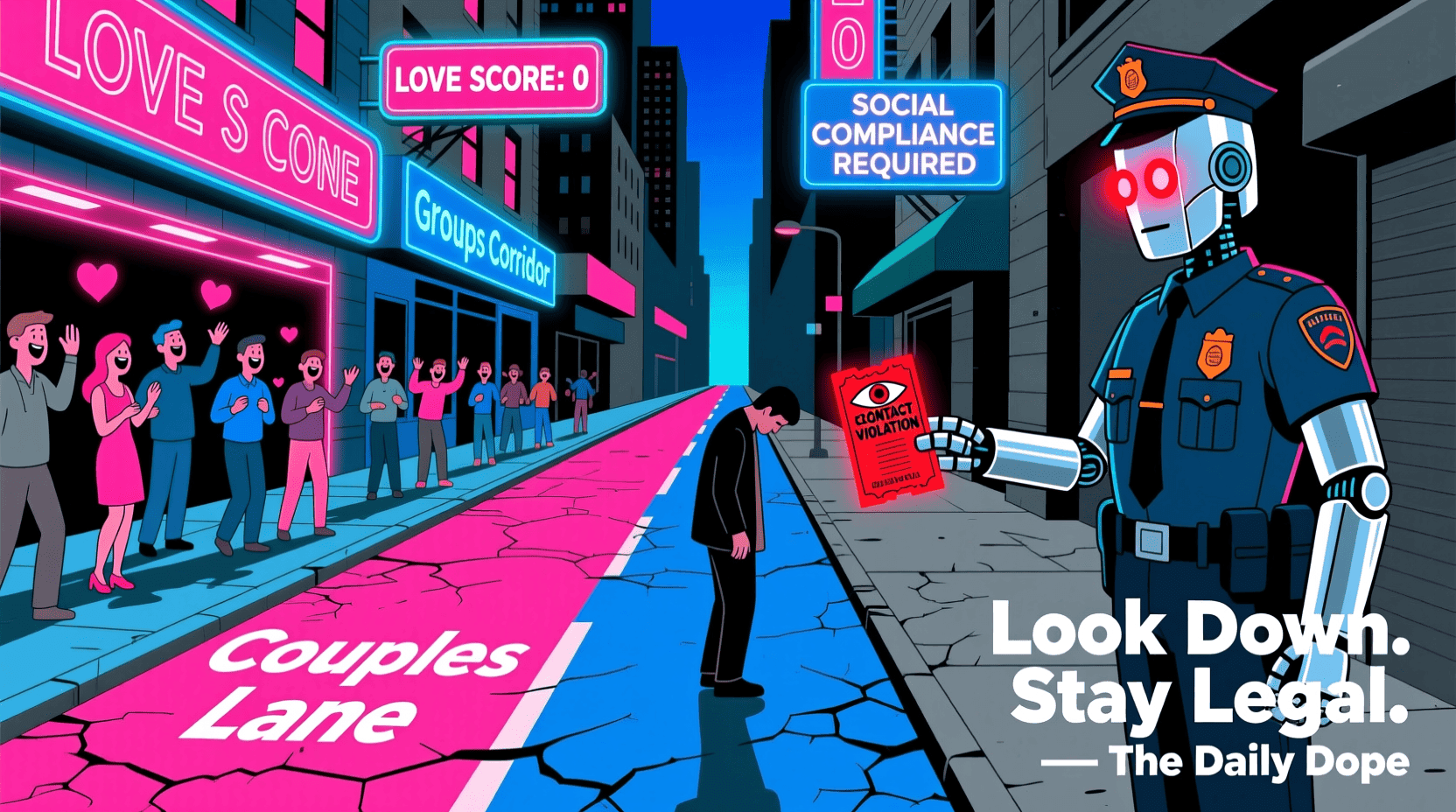
New York City no longer just avoids eye contact—it fines you for it. In a move that blends dystopian theater with municipal overreach, the Department of Public Harmony has rolled out **“Eye Contact Enforcement Zones”** across Manhattan, Brooklyn, and Queens. Make sustained eye contact with a stranger for more than 0.8 seconds, and you’ll receive a $75 citation for “unauthorized emotional engagement.” The goal? To “reduce social friction, enhance pedestrian flow, and protect the right to invisibility.” This isn’t urban planning. It’s the criminalization of human recognition.
The Viral Myth of the Eye Contact Ban
The pitch is deceptively rational: “In a city of 9 million, not every glance needs to mean something.” Press materials call it “a safety innovation” and “a tool for anxiety reduction.” One city official declared: “If you’re not in a relationship, your eyes should be on the pavement.”
However, the reality is far more absurd. Two satirical citizen reactions capture the mood:
“I got fined for glancing at a barista while ordering oat milk. The officer said my ‘lingering gaze’ implied expectation of service. I just wanted caffeine.” — @LookAwayNYC
“My dog made eye contact with a pigeon. Animal Control showed up. They’re now in mandatory ‘interspecies de-escalation training.’” — @UrbanSurvivor
Consequently, the myth—that this is about efficiency—quickly unravels. Ultimately, it’s urban alienation codified into law.
The Absurd Mechanics of Visual Policing
After walking through three enforcement zones (and receiving one warning), we uncovered the full protocol:
- 0.0–0.8 seconds: Legal. Acceptable for navigation.
- 0.9–1.5 seconds: “Suspicious lingering.” Verbal warning + mandatory blink training.
- 1.6+ seconds: “Emotional trespassing.” Fine + court-mandated “Digital Detox” (20 minutes of scrolling).
Enforcement is handled by “Social Flow Officers”—part human, part AI-equipped with gaze-tracking sunglasses. Violations are logged in real time via city-issued smart lenses. One officer told us: “We don’t punish eye contact. We punish hope.”
Furthermore, fines increase during “high-vibes” events like Pride or Fashion Week—when emotional risk is deemed “elevated.”
The Merchandising of Avoidance
Of course, there’s merch. Because no civic absurdity is complete without a branded coping mechanism.
- “I Was Fined for Looking Alive” T-shirt
- “Certified Invisible” enamel pin
- A $40 “Anti-Gaze Kit” (includes tinted lenses, a “Do Not Engage” scarf, and sidewalk-staring practice cards)
Hence, your right to be unseen becomes a lifestyle. Therefore, you’re not lonely—you’re compliant.
The Reckoning: When Connection Becomes a Crime
This law didn’t emerge in a vacuum. It’s the logical endpoint of a culture that treats human interaction as risk and isolation as efficiency.
As we explored in How to Avoid Neighbors, modern urban life is built on stealth and evasion. And as shown in Eye Contact With Strangers, even a glance can trigger existential dread in the overstimulated city dweller.
High-authority sources confirm the drift:
- Pew Research finds 67% of urbanites report feeling “overwhelmed by social demands” in public.
- American Psychological Association warns that chronic avoidance increases loneliness and social anxiety.
- NYC Mayor’s Office admits the ban is “experimental”—but claims pilot zones saw a 24% drop in “unwanted conversations.”
Thus, the real cost isn’t the $75 fine. Ultimately, it’s the erasure of spontaneous human warmth in the name of “civic peace.”
The Hidden Irony: Who Really Benefits?
Let’s be clear: this isn’t about public safety. It’s about aesthetics. Tourists prefer sidewalks that look “vibrant but orderly”—not messy with real human connection. By corralling eye contact into fines, the city curates a cleaner, more marketable streetscape.
One former city planner admitted anonymously: “We don’t care if you’re lonely. We care that Times Square looks like a rom-com, not a existential crisis.”
And it works. Since rollout, social media posts tagged #NYCvibes have increased by 38%. Not because the city is friendlier—but because the lonely are now out of frame.
Conclusion: The Cynical Verdict
So go ahead. Stare at your shoes.
Scroll aggressively.
Wear sunglasses indoors.
But don’t call it safety.
Call it surrender with a municipal code.
And tomorrow? You’ll probably report someone for smiling too long…
because your comfort is now a public service.
After all—in 2025, the most dangerous thing in New York isn’t crime. It’s connection.
