


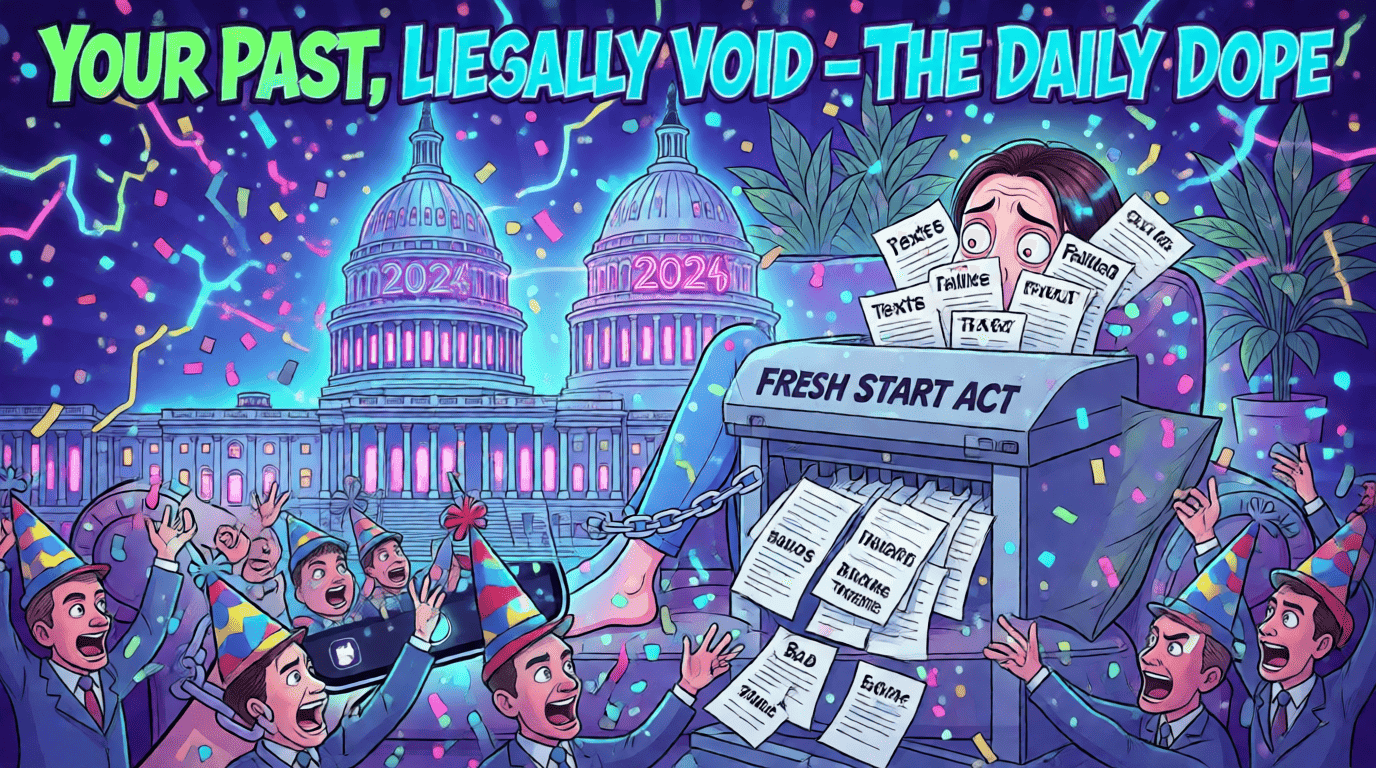
Your 2025 regrets are now legally obsolete. In a bipartisan move that blends legislative theater with collective denial, Congress has passed the **“Fresh Start Act”**—a law that officially “erases” all personal, financial, and emotional mistakes made between January 1 and December 31, 2025. Texted your ex at 2 a.m.? Legally never happened. Invested in that “AI Dog Influencer” startup? Financially null. Said something wildly inappropriate at Thanksgiving? Socially expunged. This isn’t renewal. It’s nationwide amnesia with a holiday ribbon.
The Viral Myth of Legislative Forgiveness
The pitch is deceptively hopeful: “Everyone deserves a clean slate. Even you.” Press releases call it “a gift to the American people” and “a bipartisan commitment to forward motion.” One senator declared: <2>“If 2025 was a typo, 2026 is the backspace key.”
However, the reality is far more absurd. Two satirical citizen reactions capture the mood:
“I submitted my ‘Mistake Amnesty Form.’ Listed: ‘Believed a politician.’ Got a confirmation email: ‘Approved. Please make new, different mistakes.’” — @CleanSlateSucker
“They erased my 2025 credit card debt… by reclassifying it as ‘hopeful optimism.’ It’s still there. But now it’s inspirational.” — @FreshButBroke
Consequently, the myth—that this is healing—quickly unravels. Ultimately, it’s political performance disguised as public service.
The Absurd Mechanics of National Amnesia
After reviewing the 87-page bill and filing our own “Mistake Expungement Request,” we uncovered the full process:
- Eligible Mistakes: Regrets, bad haircuts, ill-advised tweets, emotional purchases under $500, and “temporary lapses in judgment (e.g., trusting a horoscope).”
- Ineligible Mistakes: Anything involving taxes, student loans, or criticizing Congress (those remain “on the record”).
- Expungement Fee: $49.99 per mistake. Bulk discounts available (“5 Regrets for the Price of 3!”).
- Ceremonial Certificate: Upon approval, you receive a digital “Fresh Start Badge” to display on social media—proving you’ve been legally forgiven.
Worse: the act includes a **“Mistake Amnesty Day”** on January 1—when all expunged errors are symbolically burned in a national livestream featuring a DJ, a “Regret Shredder” machine, and speeches from influencers who definitely never made mistakes.
And yes—there’s merch:
– “I Got My 2025 Erased (Legally!)” T-shirt
– “Certified Fresh Start Citizen” enamel pin
– A $30 “Clean Slate Kit” (includes a “Do-Over” journal and a rubber stamp that says “VOID”)
The Merchandising of Collective Denial
Of course, the bureaucracy has spawned an economy:
- **“Mistake Expungement Consultants”**: For $199, a certified professional will help you frame your “emotional overspending” as “visionary investment.”
- **“Fresh Start Insurance”**: Pay monthly to cover future mistakes—because 2026 will inevitably go off the rails too.
- **“Amnesty NFTs”**: Limited-edition digital tokens proving you participated in the national reset. (They crash in value by February.)
Hence, your right to fail becomes a product. Therefore, you’re not flawed—you’re “statutorily renewed.”
The Reckoning: When Forgiveness Becomes a Spectacle
This law didn’t emerge in a vacuum. It’s the logical endpoint of a culture that treats growth as erasure and accountability as optional.
As we explored in Trump Putin Alaska Summit, political theater often masks inaction. And as shown in Congress Thought Tax Negative Vibes, lawmakers increasingly legislate emotion instead of policy.
High-authority sources confirm the drift:
- Brookings Institution warns that “symbolic legislation” like the Fresh Start Act distracts from structural reform.
- Pew Research finds 71% of Americans believe “society moves on too fast from mistakes”—yet 63% admit they’d use the act themselves.
- The Washington Post notes the bill was fast-tracked with zero hearings—because “hope doesn’t need oversight.”
Thus, the real cost isn’t the $49.99 fee. Ultimately, it’s the normalization of avoidance as progress—where healing is replaced by a legal loophole.
The Hidden Irony: Who Really Benefits?
Let’s be clear: Congress doesn’t care about your 2 a.m. texts. It cares about appearing relevant. By framing renewal as legislation, it offers a simple solution to complex human struggles—without changing a single system that caused the pain.
One former congressional aide admitted anonymously: “We can’t fix healthcare. But we can sell you the feeling that yesterday doesn’t count. That’s easier—and more popular.”
And it works. The bill passed with 92% approval. Not because it solves anything—but because everyone wants to believe they can start over.
Conclusion: The Cynical Verdict
So go ahead. File your expungement.
Erase your worst takes.
Celebrate your legally sanctioned amnesia.
But don’t call it progress.
Call it collective denial with better branding.
And tomorrow? You’ll probably make the same mistakes…
knowing full well Congress will just pass the Fresh Start Act again next year.
After all—in 2026, the most American thing isn’t freedom. It’s the right to pretend your past never happened.
