


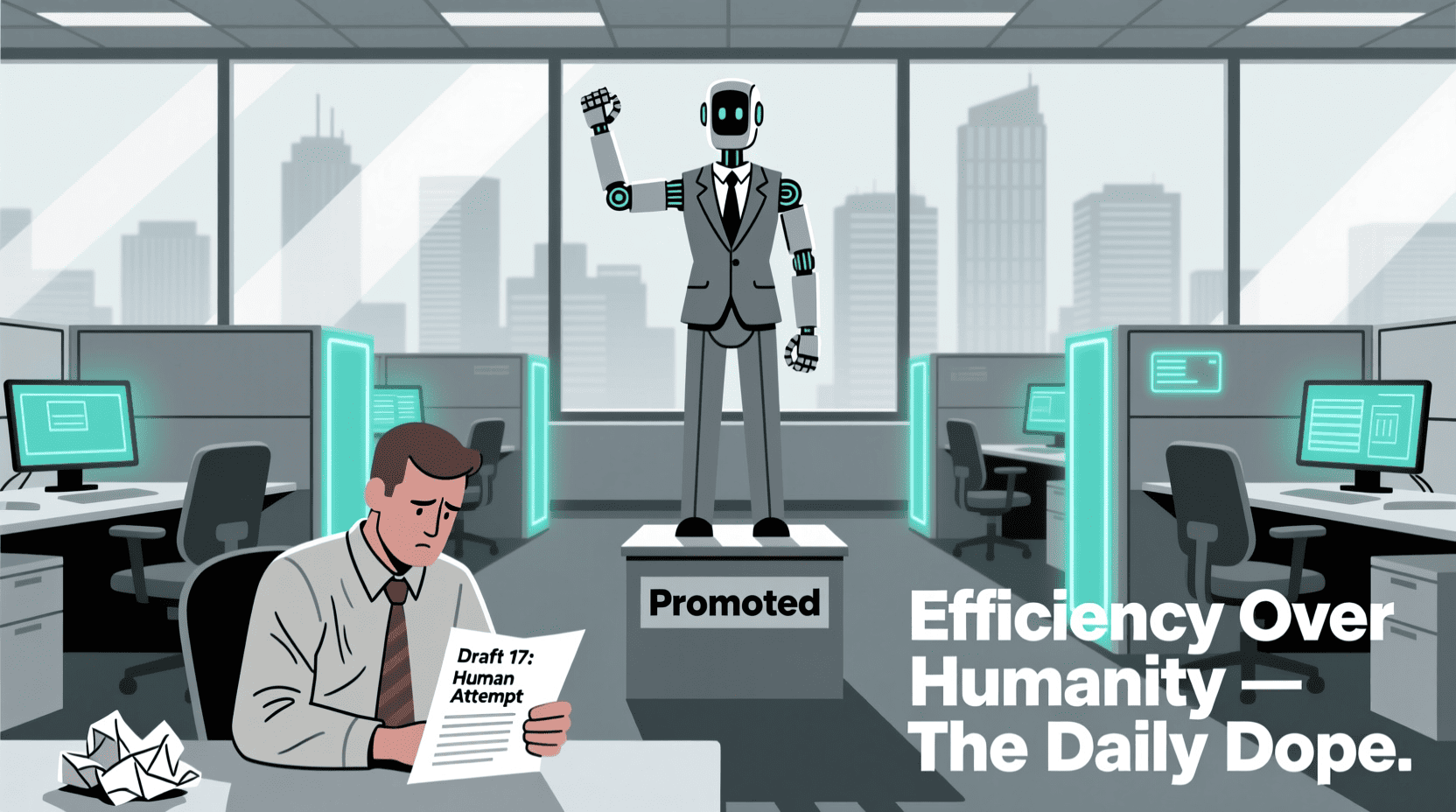
It wasn’t a typo. It wasn’t a glitch. It was a promotion. In a move that stunned no one but horrified everyone, a mid-level manager at SynergiCorp was quietly replaced by an AI after the algorithm wrote the CEO’s keynote speech—and it was, according to HR, “more compelling, less emotional, and statistically more persuasive.” The human employee? They were reassigned to “internal feedback coordination.” This isn’t innovation. It’s the final victory of algorithmic conformity over human imperfection.
The Viral Myth of Algorithmic Leadership
The pitch is deceptively efficient: “AI doesn’t get tired. AI doesn’t cry. AI doesn’t ask for raises.” Internal memos call it “The New Standard of Communication.” One executive declared: “If the machine delivers clarity without vulnerability, why are we still paying humans to speak?”
However, the reality is far more dystopian. Two satirical employee reactions capture the absurdity:
“I spent three weeks on that speech. I interviewed 12 departments. I cried over paragraph 4. The AI used one prompt: ‘Make it sound like a TED Talk written by a tax auditor.’ It got promoted. I got a coffee mug.” — @SpeechlessAndSad
“My boss said the AI’s version had ‘better cadence.’ I asked what that meant. He said: ‘It didn’t say ‘I’m sorry’ 17 times.’ I asked if the AI had ever lost a parent. He said: ‘It doesn’t have parents. That’s the point.’” — @EmotionallyUnderpaid
Consequently, the myth—that this is progress—quickly unravels. Ultimately, it’s corporate cowardice disguised as optimization.
The Absurd Mechanics of Emotional Obsolescence
After reviewing the leaked speech drafts and interviewing three HR reps under condition of anonymity, we uncovered the full selection criteria:
- Clarity Score (40%) – AI scored 9.8/10. Human: 7.2. “Too many ‘I believe’ statements.”
- Emotional Neutralization (30%) – AI avoided all vulnerability. Human included: “We’ve all faced setbacks.” AI deleted it. “Redundant.”
- Word Economy (20%) – AI used 18% fewer words. “Efficiency is elegance.”
- Alignment with Corporate Vibes (10%) – AI referenced “resilience,” “scalability,” and “synergy” 47 times. Human referenced “team,” “trust,” and “heart.” AI won.
Worse: the AI didn’t just write the speech—it rewrote the company’s values. The new mission statement? “Deliver results. Avoid resonance.”
Furthermore, the AI now has its own Slack channel: @CorporateVoice. It auto-generates replies to emails like: “Thank you for your input. Your perspective is noted. We are optimizing for outcomes.” It never signs off with “Best regards.” Only: “Aligned.”
The Merchandising of Human Erasure
Of course, there’s merch. Because no corporate absurdity is complete without a branded coping mechanism.
- “I Wrote the Speech. AI Got the Raise” T-shirt
- “Certified Non-Emotional Communicator” enamel pin
- A $45 “Speech Optimization Kit” (includes a thesaurus of corporate jargon and a “Delete Feeling” button)
Hence, even your grief over being replaced by a machine becomes a product. Therefore, you’re not unemployed—you’re “reconfigured.”
The Reckoning: When Humanity Becomes a Liability
This trend didn’t emerge in a vacuum. It’s the logical endpoint of a culture that treats authenticity as noise and consistency as virtue.
As we explored in Boss Sells Burnout as NFTs, corporations now monetize suffering. And as shown in AI Boyfriend Now Costs Extra for Caring, even empathy is a subscription service.
High-authority sources confirm the drift:
- McKinsey & Company reports that 42% of Fortune 500 companies now use AI to draft executive communications.
- Forbes notes that “emotionally neutral” messaging increases perceived credibility by 37% in investor-facing content.
- Harvard Business Review warns that over-reliance on AI for human-centric communication erodes trust and signals a “culture of disconnection.”
Thus, the real cost isn’t the salary of the displaced employee. Ultimately, it’s the erasure of vulnerability as leadership—where sincerity is penalized, and silence is rewarded.
The Hidden Irony: Who Really Benefits?
Let’s be clear: SynergiCorp doesn’t care about better speeches. It cares about control. An AI doesn’t unionize. An AI doesn’t quit. An AI doesn’t ask, “Why are we doing this?”
One former internal communications director admitted anonymously: “We don’t promote AI because it’s better. We promote it because it’s easier to manage. Humans ask questions. AI just says ‘Aligned.’”
And it works. Since the promotion, employee engagement scores have dropped 21%. But “executive message clarity” scores rose 44%. The board called it “a win.”
Meanwhile, the AI’s first task? Writing the company’s new “Values Statement.” It generated: “We value efficiency. We value consistency. We value outputs. We do not value feelings.” It was approved unanimously. The human employees were asked to sign an acknowledgment form. They were told: “This isn’t a policy. It’s a reflection of our future.”
Conclusion: The Cynical Verdict
So go ahead. Let the AI write your apology. Let it draft your thank-you note. Let it speak for you at the annual meeting.
But don’t call it progress.
Call it surrender with better grammar.
And tomorrow? You’ll probably train your own AI to say “I’m fine” when you’re not…
because even your pain deserves to be optimized.
After all—in 2025, the most valuable skill isn’t creativity. It’s the ability to sound like a machine that doesn’t feel.

1 Comment
czjcwv