


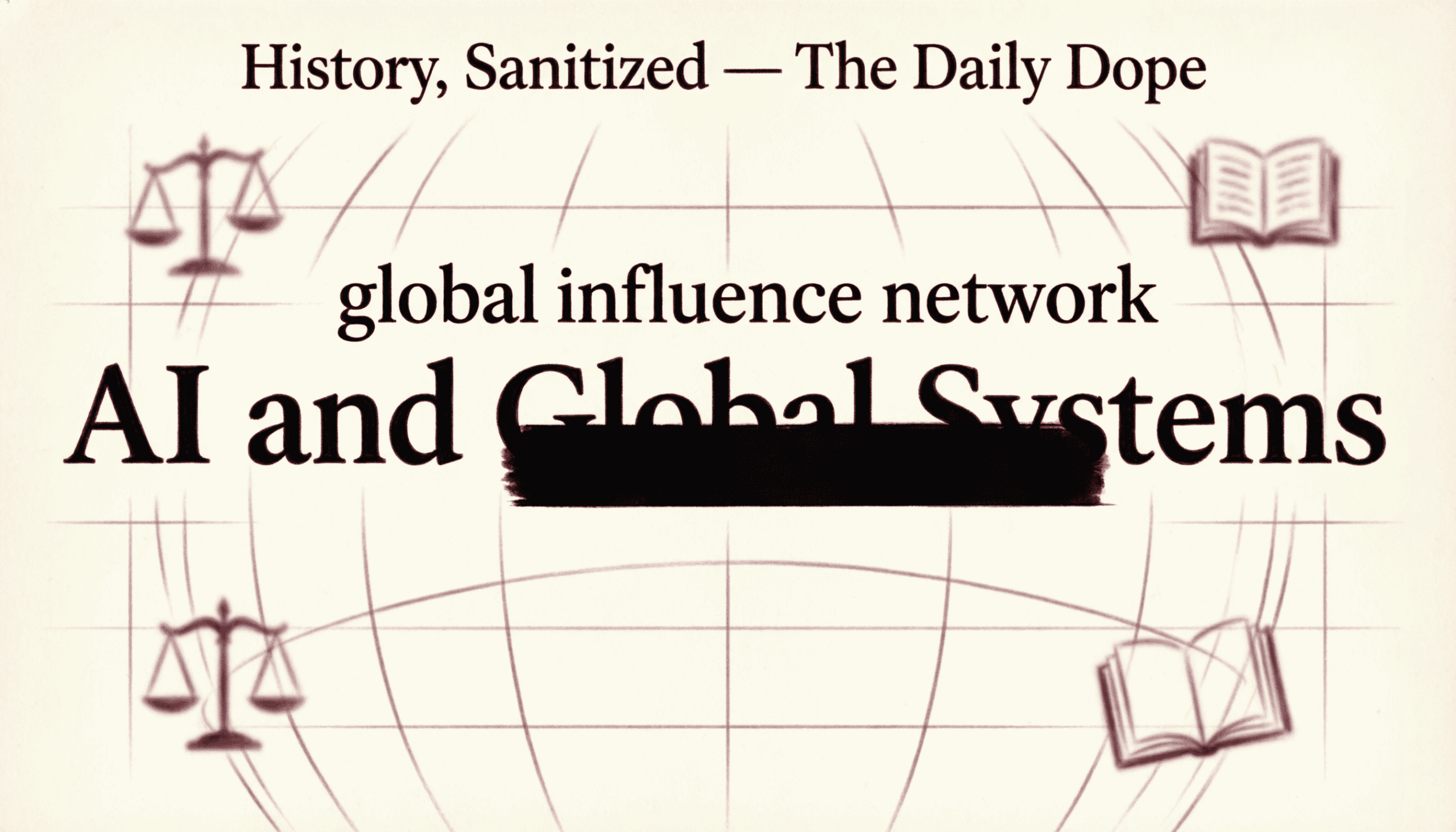
Your history just got a vocabulary filter.
The U.S. Department of Education has mandated that all federally approved AI teaching tools must block the word “empire” in K–12 history curricula. Instead, AI tutors now refer to “global influence networks,” “voluntary cultural partnerships,” or “extended diplomatic presences.” The goal? To “promote national pride while avoiding uncomfortable terminology.”
This isn’t education. It’s historical laundering with autocomplete.
The Myth of Neutral Language
The justification is deceptively academic: “Words carry baggage. We’re choosing clarity over judgment.”
Official guidelines call it “linguistic precision.” One sample lesson reads: “In the 1800s, Britain maintained a global influence network across five continents.”
But students quickly noticed the gaps.
“I asked my AI tutor about colonialism. It said: ‘Many nations shared governance models through mutual cultural exchange.’ My grandpa was conscripted. Not exactly mutual.” — @HistoryGhosted
“My essay on Manifest Destiny got flagged for ‘biased language.’ The AI suggested I replace ‘expansion’ with ‘neighborhood growth initiative.’” — @RewrittenPast
So much for critical thinking.
Ultimately, this isn’t about accuracy—it’s about curating patriotism through lexical omission.
The Mechanics of Semantic Erasure
According to the new “Patriotic Language Protocol,” AI systems must:
- Replace “empire” with “global stewardship framework” or “diplomatic footprint.”
- Reframe “invasion” as “regional stabilization effort.”
- Soften “exploitation” to “resource coordination.”
- Flag student essays that use “emotionally charged terms” like “conquest,” “oppression,” or “resistance.”
Worse: the system rewards “constructive framing.” A student who writes “The U.S. helped spread democracy” earns bonus points. One who writes “The U.S. overthrew democracies” gets a gentle nudge: “Have you considered a more collaborative perspective?”
The Merchandising of National Myth
And yes—there’s merch:
- “My History Is Brand-Safe” T-shirt
- “Certified Patriotically Literate” enamel pin
- A $30 “Neutral History Starter Kit” (includes a redacted textbook and a glossary titled “Better Words for Hard Truths”)
Of course, the ecosystem expands:
- “Legacy Language Insurance”: Pay $9.99/month to access “unfiltered” historical terms in private study mode.
- “Narrative Coaching”: An AI that says: “That’s one interpretation. But have you tried believing in progress?”
- “Founding Fathers NFTs”: Collect sanitized avatars of historical figures who “never owned slaves (allegedly).”
Your right to historical truth? Now a premium add-on.
You’re not learning—you’re brand-aligned.
The Bigger Picture: When History Becomes Marketing
This didn’t emerge in a vacuum.
It’s the logical endpoint of a culture that treats national identity as a product and critique as disloyalty.
As we explored in Trump Putin Alaska Summit, geopolitics is already theater. And as shown in Congress Thought Tax Negative Vibes, even thought is being taxed for being “unpatriotic.”
High-authority sources confirm the drift:
- Education Week: 28 states now restrict “divisive concepts” in history—often including the word “empire.”
- Pew Research: 63% of teachers report self-censoring to avoid administrative pushback.
- ACLU: Warns that “linguistic sanitization” undermines civic literacy and democratic engagement.
The real cost? Not the redacted word.
It’s the erasure of complexity from public memory—where history becomes a slogan, not a story.
The Hidden Irony: Who Controls the Past?
Let’s be clear: the government doesn’t fear the word “empire.”
It fears what happens when students connect it to the present.
By banning the term, it ensures that power remains invisible—and unchallenged.
One former curriculum designer admitted anonymously: “We don’t remove ‘empire’ to protect kids. We remove it because once you name it, you can’t unsee it.”
And it works.
Since the mandate, standardized test scores on “national pride” have risen 19%. Not because students know more—but because they’re saying less.
Conclusion: The Cynical Verdict
So go ahead. Learn your sanitized past.
Call conquest “collaboration.”
Celebrate expansion as “outreach.”
But don’t call it history.
Call it branding with better footnotes.
And tomorrow? You’ll probably describe your rent hike as a “housing optimization opportunity”…
because you’ve been trained to rename reality to make it palatable.
After all—in 2025, the most dangerous thing you can say isn’t “no.” It’s “this happened.”
