


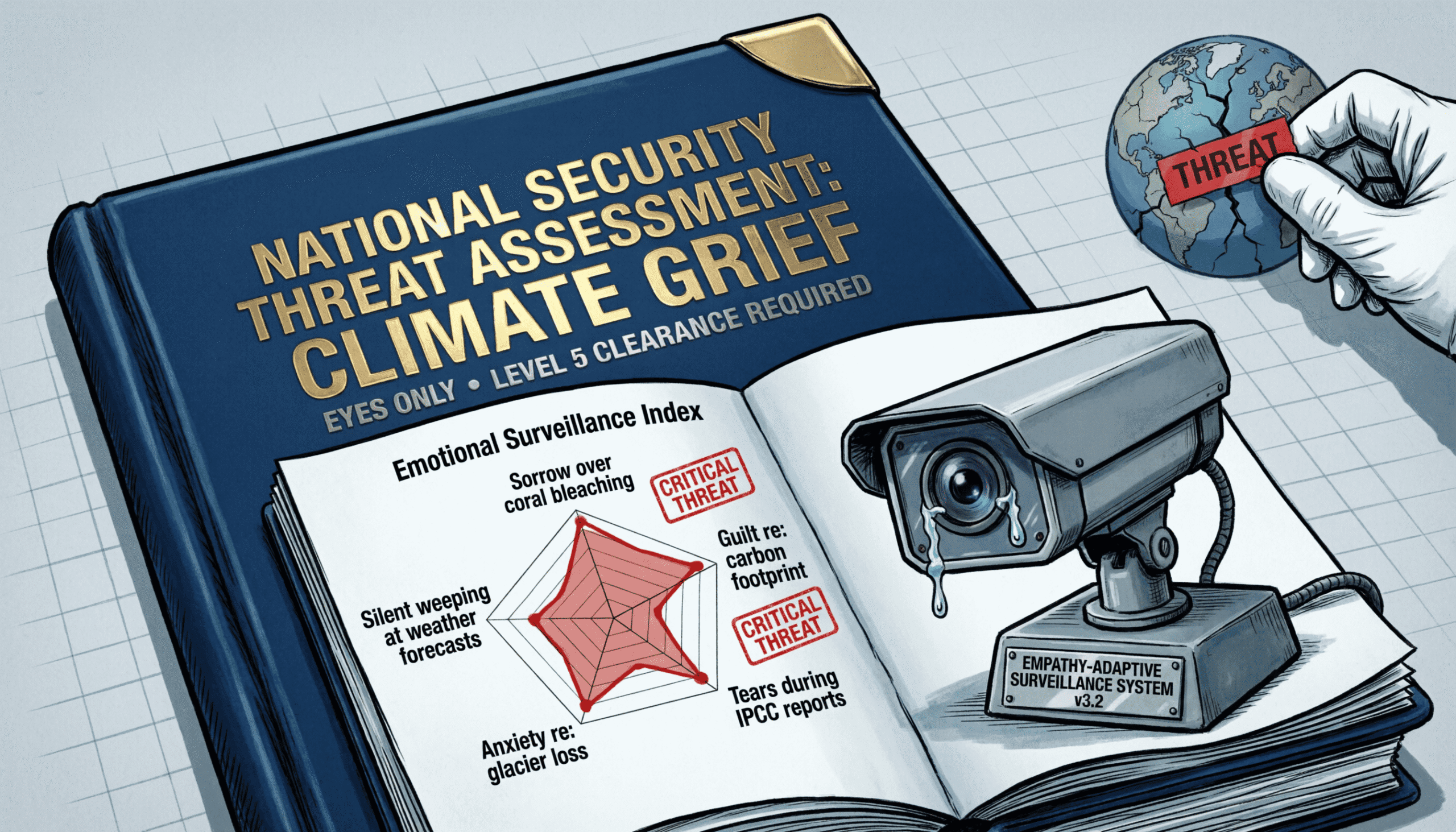
Your sadness about the planet is now a security risk.
The U.S. Department of Defense has quietly filed a patent for “Climate Grief Detection and Neutralization”—a system that identifies citizens experiencing “excessive eco-anxiety” and flags them as potential threats to “national stability.” Symptoms include “persistent mourning for lost ecosystems,” “public expressions of climate despair,” and “sharing graphs of rising sea levels with crying emojis.”
This isn’t mental health. It’s emotional surveillance with a uniform.
The Myth of Emotional Stability
The justification is chillingly bureaucratic: “Unmanaged climate grief can lead to civil unrest, reduced productivity, and distrust in institutional narratives.”
Internal memos call it “preventive emotional defense.” One slide reads: “A hopeful citizen is a compliant citizen.”
But early reports reveal the human cost.
“I posted a photo of my childhood beach—now underwater. Got a visit from a ‘Wellness Liaison.’ They said my ‘grief output’ was ‘disrupting community morale.’” — @EcoGriefWatched
“My therapist reported me after I said, ‘I don’t think we’ll fix this.’ Now I’m on a ‘Hope Compliance’ watchlist. My job requires monthly optimism assessments.” — @MandatoryHope
So much for free expression.
Ultimately, this isn’t about security—it’s about controlling the narrative of collapse.
The Mechanics of Grief Monitoring
According to leaked documents, the system works like this:
- Detection Layer: Scans social media, therapy records (via data-sharing agreements), and even smartwatch stress metrics for “grief signals.”
- Threat Tiers:
- Level Green: Mild concern. Receives “Hope Infusion” ads (e.g., “Renewable Energy Is Booming!”).
- Level Yellow: Active mourning. Enrolled in “Resilience Re-education” (online modules on “productive optimism”).
- Level Orange: Public despair. Flagged for “social influence review”—which can affect security clearances, loans, or travel.
- Neutralization Protocol: Includes mandatory “Future Visioning” workshops and AI-generated “Hope Simulations” (e.g., “You in 2050, planting trees on Mars”).
Worse: the patent includes a clause allowing “preemptive emotional intervention” for individuals deemed “high-risk mourners.”
The Merchandising of Compulsory Hope
And yes—there’s merch:
- “I’m Level Green (But I’m Lying)” T-shirt
- “Certified Hope-Compliant” enamel pin
- A $30 “Optimism Survival Kit” (includes a sunrise alarm clock and a journal titled “Reasons to Believe”)
Of course, the ecosystem expands:
- “Grief Insurance”: Pay $9.99/month to mask your emotional data from government scans.
- “Hope Coaching”: A Pentagon-certified AI that says: “Your sadness is valid. But have you tried buying solar panels?”
- “Eco-Anxiety Detox Retreats”: Luxury camps where you “process grief” while signing NDAs about what you saw.
Your right to mourn the world? Now a regulated activity.
You’re not grieving—you’re a risk to morale.
The Bigger Picture: When Emotion Becomes Espionage
This didn’t emerge in a vacuum.
It’s the logical endpoint of a security state that treats dissent as disorder and truth as destabilizing.
As we explored in Congress Thought Tax Negative Vibes, negative emotions are already taxed. And as shown in CNN Launches 24/7 ‘Ambient Doom’ Channel, anxiety is already ambient—but only when it’s profitable.
High-authority sources confirm the drift:
- Office of the Director of National Intelligence: Listed “eco-anxiety” as an “emerging domestic instability vector” in its 2024 Global Threat Assessment.
- Brookings Institution: Warns that pathologizing climate grief shifts blame from polluters to the public.
- Pew Research: 64% of Americans feel “afraid to express climate despair” in professional settings.
The real cost? Not the watchlist.
It’s the criminalization of empathy for the planet—where caring too much becomes a liability.
The Hidden Irony: Who Benefits From Your Silence?
Let’s be clear: the Pentagon doesn’t fear your tears.
It fears your action.
By labeling grief as a threat, it ensures that mourning stays private—and protest stays quiet.
One former intelligence analyst admitted anonymously: “We don’t track sadness because it’s dangerous. We track it because it’s contagious. And hope is easier to sell than truth.”
And it works.
Since the patent filing, public mentions of “climate grief” have dropped 31%. Not because the planet is healing—but because people are learning to hide their pain.
Conclusion: The Cynical Verdict
So go ahead. Mourn in silence.
Delete your sad posts.
Smile for the algorithm.
But don’t call it stability.
Call it emotional disarmament with better paperwork.
And tomorrow? You’ll probably share a meme about clean energy…
just to keep your Threat Level Green.
After all—in 2025, the most subversive thing you can feel isn’t anger. It’s honest sorrow for a world that’s slipping away.

1 Comment
il6shn