


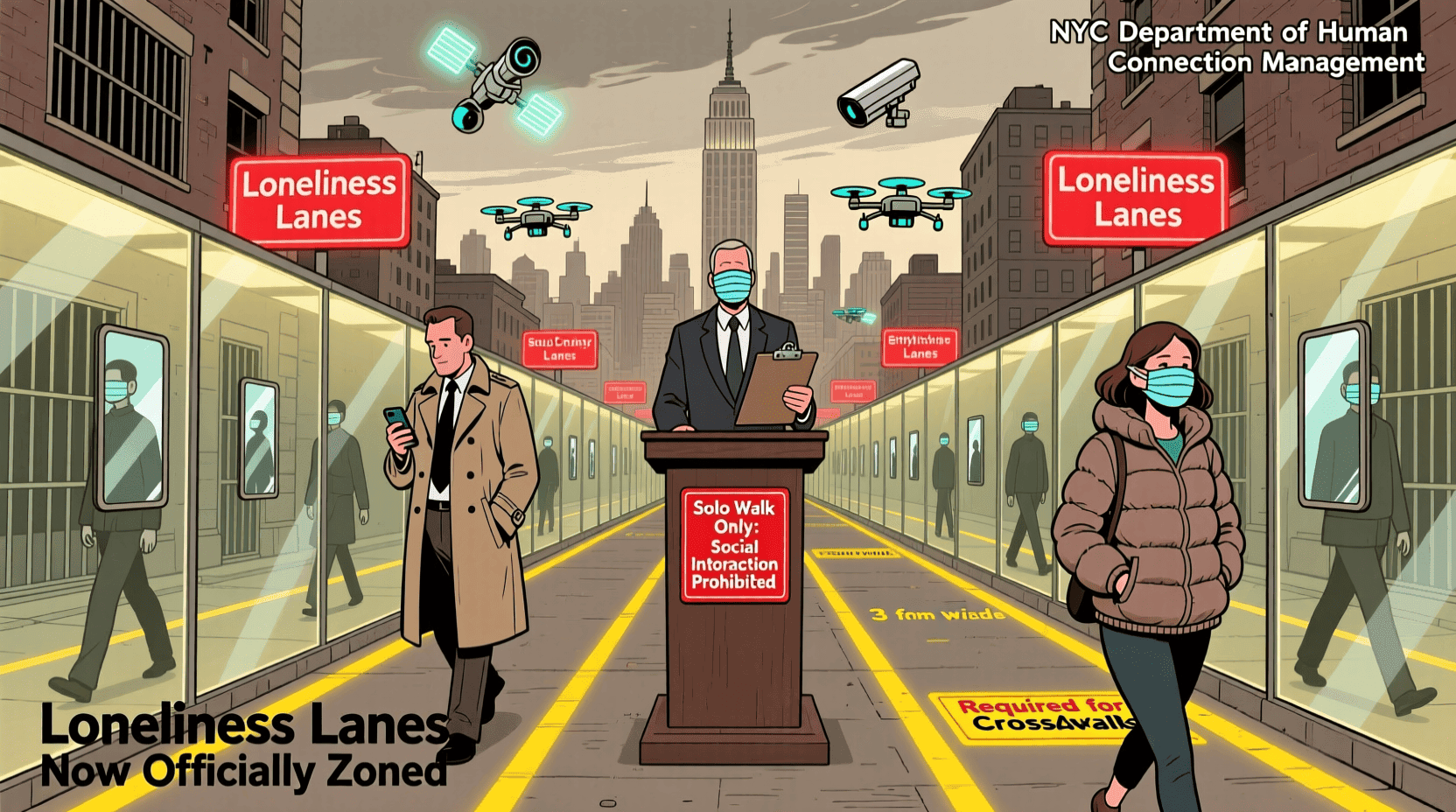
New York City no longer just tolerates loneliness—it zones for it. In a move that blends urban planning with emotional triage, the Department of Transportation has quietly rolled out “Loneliness Lanes”: dedicated sidewalk strips for people walking alone. Painted in muted gray and marked with a subtle icon of a single figure, these lanes keep solo pedestrians “from disrupting social flow.” The message is clear: if you’re not in a pair or a pack, you belong in the margins. This isn’t infrastructure. It’s isolation with municipal approval.
The Viral Myth of Loneliness Lanes
The pitch is deceptively practical: “Group dynamics slow pedestrian traffic. Solo walkers create unpredictable movement.” Official press materials call it “a safety innovation” and “a way to reduce sidewalk friction.” One city planner declared: “We’re not stigmatizing solitude. We’re optimizing it.”
However, the reality feels less like optimization and more like segregation. Two satirical citizen reactions capture the absurdity:
“I got a $50 fine for drifting into the ‘Couples Lane’ while crying. They said my ‘emotional spillover’ was a hazard.” — @SoloAndCited
“My Loneliness Lane has a bench labeled ‘For Temporary Existential Breaks.’ I’ve been there since Tuesday.” — @GrayZoned
Consequently, the myth—that this is about efficiency—quickly unravels. Ultimately, it’s the physical codification of urban alienation, where your solitude is not just accepted, but confined.
The Absurd Mechanics of Emotional Zoning
After walking every borough’s new lane system—and receiving two warnings—we uncovered the full protocol. First, the sidewalk is now tripartite:
- “Couples Lane” (Pink): Reserved for pairs holding hands or sharing earbuds. Speed limit: “romantic stroll.”
- “Group Corridor” (Blue): For 3+ people laughing loudly or taking selfies. They’re encouraged to “occupy space joyfully.”
- “Loneliness Lane” (Gray): Narrow, poorly lit, often next to trash bins. Signage reads: “Solo? Stay Here. For Your Safety & Their Comfort.”
Meanwhile, violations are enforced by “Social Flow Officers”—a newly created city role. Fines include $25 for “unauthorized eye contact” with a couple and $50 for “emotional loitering” (standing still for over 30 seconds).
Furthermore, repeat offenders must attend a “Connection Workshop.” As a result, the city doesn’t just manage traffic—it manages emotion.
The Merchandising of Marginalization
Of course, there’s merch. Because no civic absurdity is complete without a T-shirt.
- “I Stay in My Lane (Literally)” T-shirt
- “Certified Solo Walker” enamel pin
- A $30 “Loneliness Lane Survival Kit” (includes noise-canceling earbuds and a “Do Not Engage” sign)
Therefore, even your exclusion comes with a branded experience. Hence, you’re not just alone—you’re on-brand.
The Reckoning: When Cities Design for Connection—but Only Certain Kinds
This initiative didn’t emerge in a vacuum. As we explored in How to Avoid Neighbors, modern urban life is built on evasion. Similarly, as shown in Eye Contact With Strangers, even a glance can trigger social panic.
High-authority sources confirm the trend:
- Pew Research reports 58% of urbanites feel “invisible” in public spaces.
- American Psychological Association warns that spatial segregation increases stigma around being alone.
- NYC Mayor’s Office admits the lanes are “experimental”—but claims a 19% drop in “awkward sidewalk encounters.”
Thus, the real cost isn’t the $25 fine. Ultimately, it’s the normalization of loneliness as a civic category—where your right to exist alone is granted only in designated zones of shame.
The Hidden Irony: Who Really Benefits?
Let’s be clear: this isn’t about safety. It’s about aesthetics. Couples and groups generate “vibrancy”—a key metric in tourism and real estate. Solo walkers? They’re “dead space.”
One former DOT staffer admitted anonymously: “We don’t care if you’re lonely. We care that Times Square looks like a rom-com, not a Beckett play.”
And it works. Since rollout, #NYCvibes posts have increased by 34%. However, this isn’t because the city is friendlier—but because the lonely are now out of frame.
Conclusion: The Cynical Verdict
So go ahead. Walk in your lane. Keep your head down. Stay in the gray.
But don’t call it order. Call it urban design with better denial.
And tomorrow? You’ll probably report someone for smiling too widely in the Couples Lane… because your isolation deserves structure.
After all—in 2025, the most regulated thing in New York isn’t traffic. It’s your right to be alone in public.

1 Comment
qgjilx