


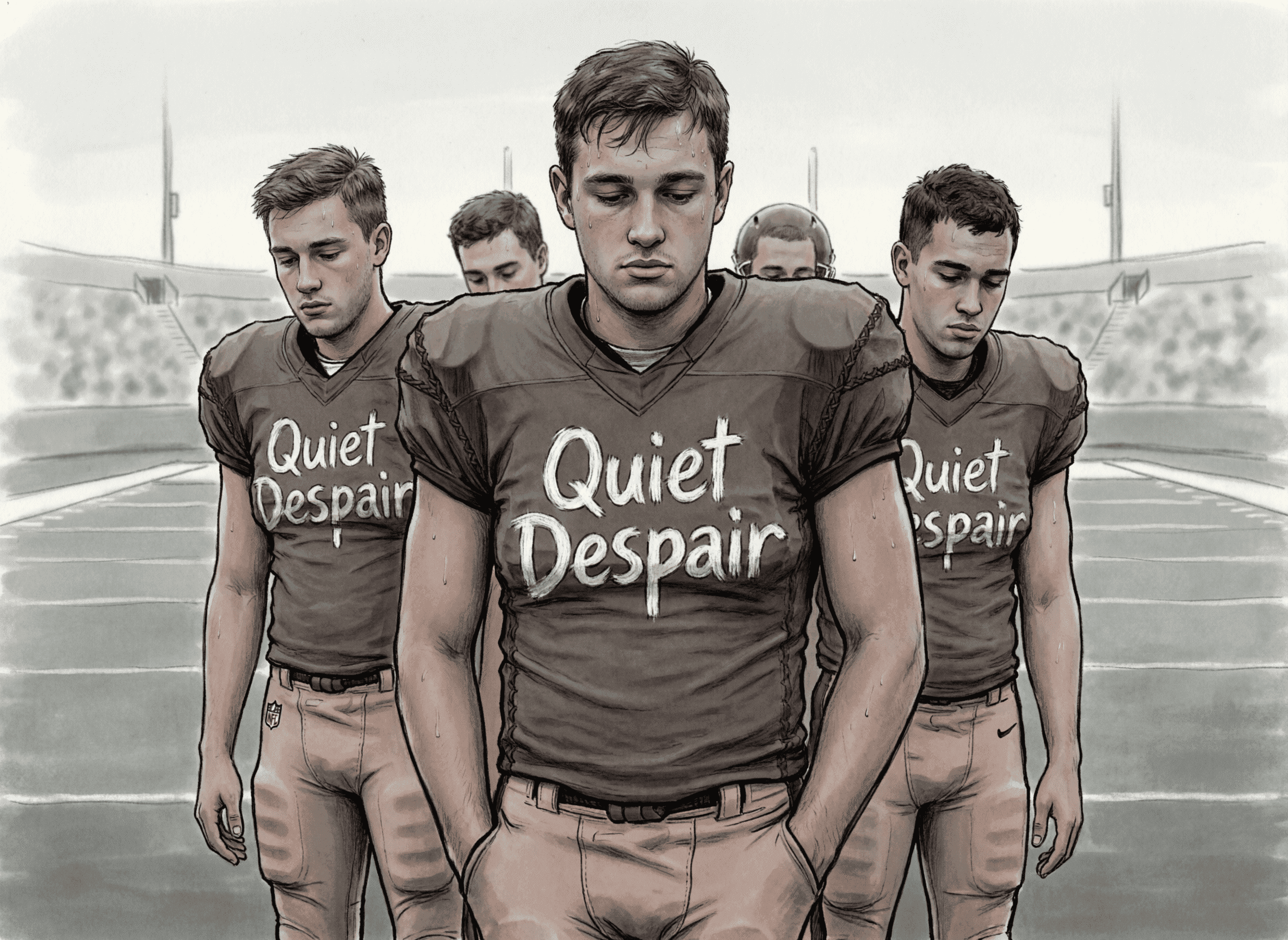
Your favorite linebacker just got a new look—and it’s called grief.
The NFL has unveiled its latest line: “Quiet Despair” uniforms—a limited-edition off-season kit featuring oversized, slumped-shoulder jerseys in “ash gray,” “emotional beige,” and “post-holiday navy.” Designed to “honor the silent resilience of the modern man,” the uniforms come with pre-wrinkled fabric, tear-resistant mesh, and a hidden inner pocket labeled “For Feelings You’ll Never Share.”
This isn’t fashion. It’s the commodification of masculine silence.
The Myth of Stoic Strength
The pitch is deceptively poetic: “Real men don’t cry. They wear it well.”
Promotional videos show players staring into the rain, hands in pockets, as a voiceover whispers: “Strength isn’t loud. It’s what you carry alone.”
But fans saw through the performance.
“I bought the jersey. My therapist said: ‘This isn’t healing. This is trauma merch.’ I wore it anyway. It’s weirdly comfortable.” — @StoicAndSad
“The tag says ‘Machine wash cold. Do not express emotion.’ I laughed. Then I cried. Then I folded it neatly and put it away.” — @QuietlyBreaking
So much for emotional progress.
Ultimately, this isn’t about honoring men—it’s about selling their pain as a lifestyle.
The Mechanics of Aestheticized Suffering
After reviewing the product line, we uncovered the full design philosophy:
- Fabric Technology: “Emotion-Resistant Weave” prevents visible tears (both kinds).
- Color Palette:
- “Ash Gray” – for general exhaustion
- “Emotional Beige” – for suppressed longing
- “Post-Holiday Navy” – for January dread
- Hidden Details: Inside collar reads: “You’re fine.” Sleeve cuff: “Don’t worry about it.”
Worse: the league sells matching “Quiet Despair” loungewear for fans—because if you can’t talk about your feelings, you might as well dress like someone who also can’t.
The Merchandising of Emotional Silence
And yes—there’s merch:
- “I’m Fine (The Uniform)” T-shirt
- “Certified Quietly Devastated” enamel pin
- A $45 “Masculine Stillness Kit” (includes unscented deodorant and a journal titled “Thoughts I’ll Never Say Out Loud”)
Of course, the ecosystem expands:
- “Despair Styling Sessions”: Virtual consultations on how to “wear your sadness with dignity.”
- “Silent Support Subscriptions”: Monthly box of neutral-toned socks and protein bars that taste like regret.
- “Legacy of Quiet” NFTs: Own a digital fragment of a player’s most emotionally vacant post-game interview.
Your right to feel deeply? Now a seasonal collection.
You’re not hurting—you’re on-brand.
The Bigger Picture: When Pain Becomes Product
This didn’t emerge in a vacuum.
It’s the logical endpoint of a culture that treats male vulnerability as weakness and silence as strength.
As we explored in American Youth: Too Busy Being Young to Reach ‘Adult Milestones’, young adults are already drowning in delayed adulthood. And as shown in Zara Quiet Poverty Collection, even struggle is now aestheticized.
High-authority sources confirm the drift:
- American Psychological Association: Men are 3x less likely to seek therapy due to “emotional stoicism norms.”
- Pew Research: 68% of men say they “hide sadness to avoid burdening others.”
- Nielsen: “Quiet masculinity” is now a $2B marketing niche in sportswear.
The real cost? Not the $150 jersey.
It’s the normalization of emotional isolation as identity—where the only acceptable way to be a man is to suffer beautifully, silently, and on-brand.
The Hidden Irony: Who Profits From Your Silence?
Let’s be clear: the NFL doesn’t care about your mental health.
It cares about your wallet.
By turning despair into design, it ensures your pain becomes a revenue stream—not a crisis to solve.
One former brand strategist admitted anonymously: “We don’t sell jerseys. We sell permission to feel nothing—and look good doing it.”
And it works.
Pre-orders sold out in 12 hours. Not because men are healing—but because they’ve been taught that the only safe way to express pain is to wear it as a logo.
Conclusion: The Cynical Verdict
So go ahead. Buy the jersey.
Wear your silence like armor.
Look devastatingly calm in group photos.
But don’t call it strength.
Call it capitalism with better tailoring.
And tomorrow? You’ll probably fold it neatly…
and keep your real feelings in the drawer where they belong.
After all—in 2025, the most marketable thing a man can be isn’t strong. It’s quietly broken.
