


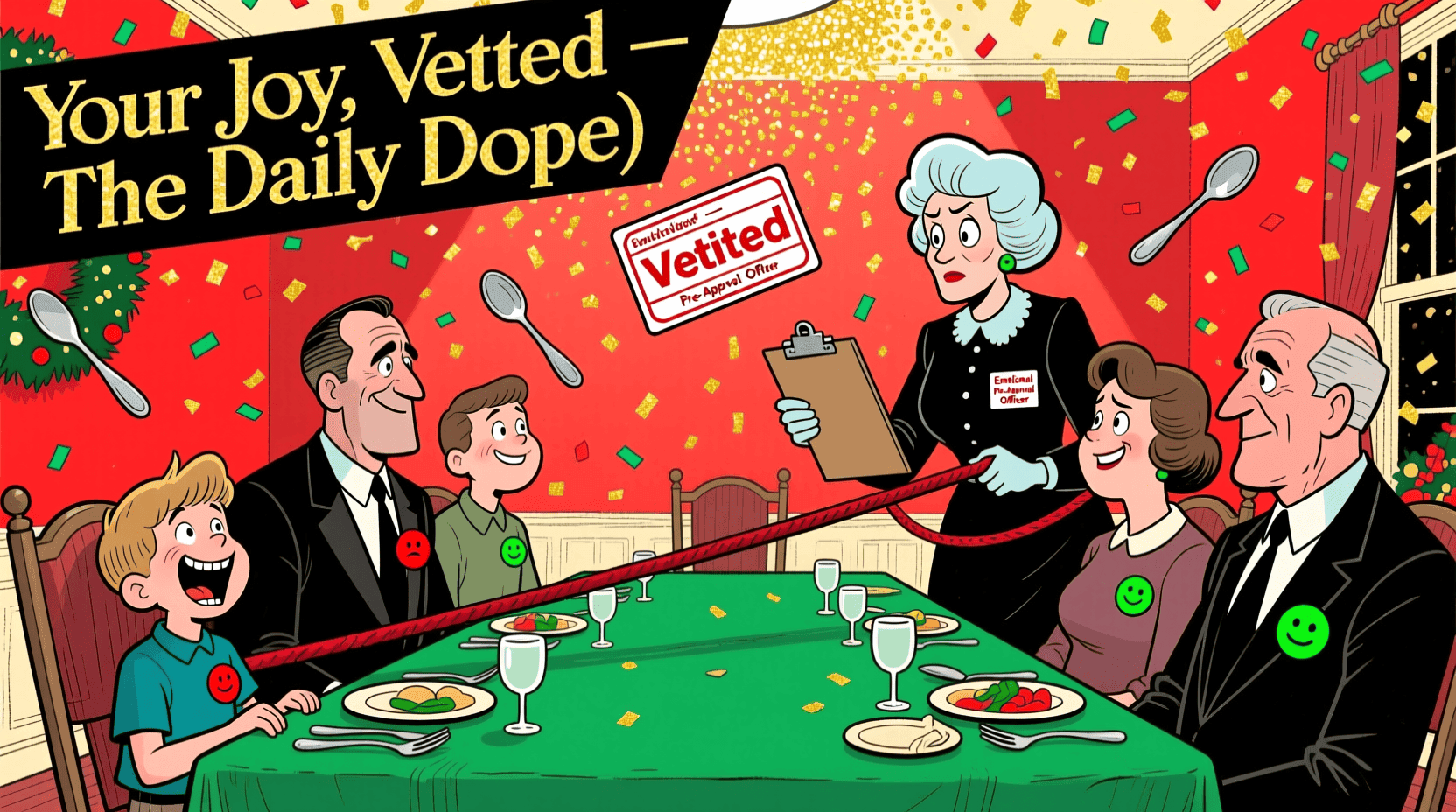
Your seat at the holiday table just got a prerequisite: **emotional pre-approval**. In a move that blends family tradition with bureaucratic overreach, dozens of households have quietly adopted a new rule: before attending the annual gathering, all guests must submit an “Emotional Readiness Form” to the designated “Family Compliance Officer” (usually Aunt Carol). Failed a relationship? You must prove you won’t “ruin the vibe.” Lost your job? Provide a “Positivity Plan.” This isn’t togetherness. It’s festive emotional gatekeeping with cranberry sauce.
The Viral Myth of Harmonious Gatherings
The pitch is deceptively warm: “We just want everyone to have a peaceful holiday.” Family group chats call it “a boundary, not a ban.” One matriarch declared: “If you’re not bringing joy, don’t bring your drama.”
However, the reality is far more dystopian. Two satirical family testimonials capture the mood:
“I had to submit a 300-word essay titled ‘Why My Existential Dread Won’t Dim the Tree Lights.’ Got conditional approval—only if I sit next to Uncle Bob, who’s ‘neutral energy.’” — @ApprovedButUnhappy
“My form was denied because I mentioned climate grief. They said: ‘Not during dessert.’ I’m spending Christmas with my cat and a frozen pizza.” — @EmotionallyBanned
Consequently, the myth—that this is about peace—quickly unravels. Ultimately, it’s control disguised as care.
The Absurd Mechanics of Festive Compliance
After reviewing actual pre-approval forms shared by six desperate readers, we uncovered the full vetting protocol:
- Mood Stability Score (0–10): Must be ≥7. Bonus points for “consistent smiling in recent photos.”
- Topic Clearance List: Allowed: weather, safe recipes, dog videos. Forbidden: politics, therapy, your “weird phase.”
- Emotional Contingency Plan: Must include: “If I feel sad, I will go to the bathroom and breathe for 5 minutes, then return with a neutral face.”
- Sponsor Requirement: You must be “vouched for” by a stable family member (i.e., someone who still believes in Santa).
Worse: non-compliance triggers “Holiday Probation.” One user reported: “I cried during grace. Now I’m on a ‘Joy Watch’ and must send daily ‘gratitude selfies’ to maintain my invite.”
And yes—there’s merch:
– “I Was Emotionally Pre-Approved (Barely)” T-shirt
– “Certified Low-Drama Relative” enamel pin
– A $25 “Holiday Survival Kit” (includes a “Safe Topics” cheat sheet and a tiny stress ball shaped like a turkey)
The Merchandising of Forced Festivity
Of course, the trend has spawned side hustles:
- **“Pre-Approval Ghostwriters”**: For $50, an expert will craft your emotional readiness essay: “I am currently experiencing manageable levels of despair.”
- **“Mood Badge Rentals”**: Wear a glowing pin that signals your approved emotional state: green = safe, yellow = cautious, red = “do not engage (unless offering wine).”
- **“Dinner Insurance”**: Pay $19.99 to guarantee a “drama-free” meal—or get reimbursed in gift cards.
Hence, your right to exist at the table becomes a service. Therefore, you’re not family—you’re *conditionally welcome*.
The Reckoning: When Togetherness Becomes a Performance
This trend didn’t emerge in a vacuum. It’s the logical endpoint of a culture that treats vulnerability as disruption and silence as harmony.
As we explored in How to Avoid Neighbors, modern life is built on emotional stealth. And as shown in Eye Contact With Strangers, even small interactions are now fraught with risk.
High-authority sources confirm the drift:
- Pew Research reports 58% of adults feel “anxious about family gatherings,” especially around holidays.
- American Psychological Association warns that suppressing emotions to “keep peace” increases long-term stress and resentment.
- NPR notes a rise in “micro-holidays”—people skipping big dinners for controlled, low-stakes meetups.
Thus, the real cost isn’t the denied invite. Ultimately, it’s the erasure of authentic connection in the name of “festive calm.”
The Hidden Irony: Who Really Controls the Table?
Let’s be clear: Aunt Carol doesn’t care about your mental health. She cares about her Pinterest-perfect holiday photos. By framing emotional honesty as “drama,” she ensures the narrative stays tidy—even if the truth is messy.
One former family compliance volunteer admitted anonymously: “We don’t want peace. We want predictability. If you’re not smiling, you’re ruining the aesthetic.”
And it works. Households using pre-approval report “smoother” dinners. Not because people are happier—but because they’ve learned to perform happiness to keep their seat.
Conclusion: The Cynical Verdict
So go ahead. Submit your form.
Promise not to mention your therapy.
Wear your green mood badge like a halo.
But don’t call it family.
Call it emotional immigration with better gravy.
And tomorrow? You’ll probably send a “gratitude selfie”…
because your presence is a privilege, not a right.
After all—in 2025, the most cherished holiday tradition isn’t love. It’s the lie that everyone’s fine.
