


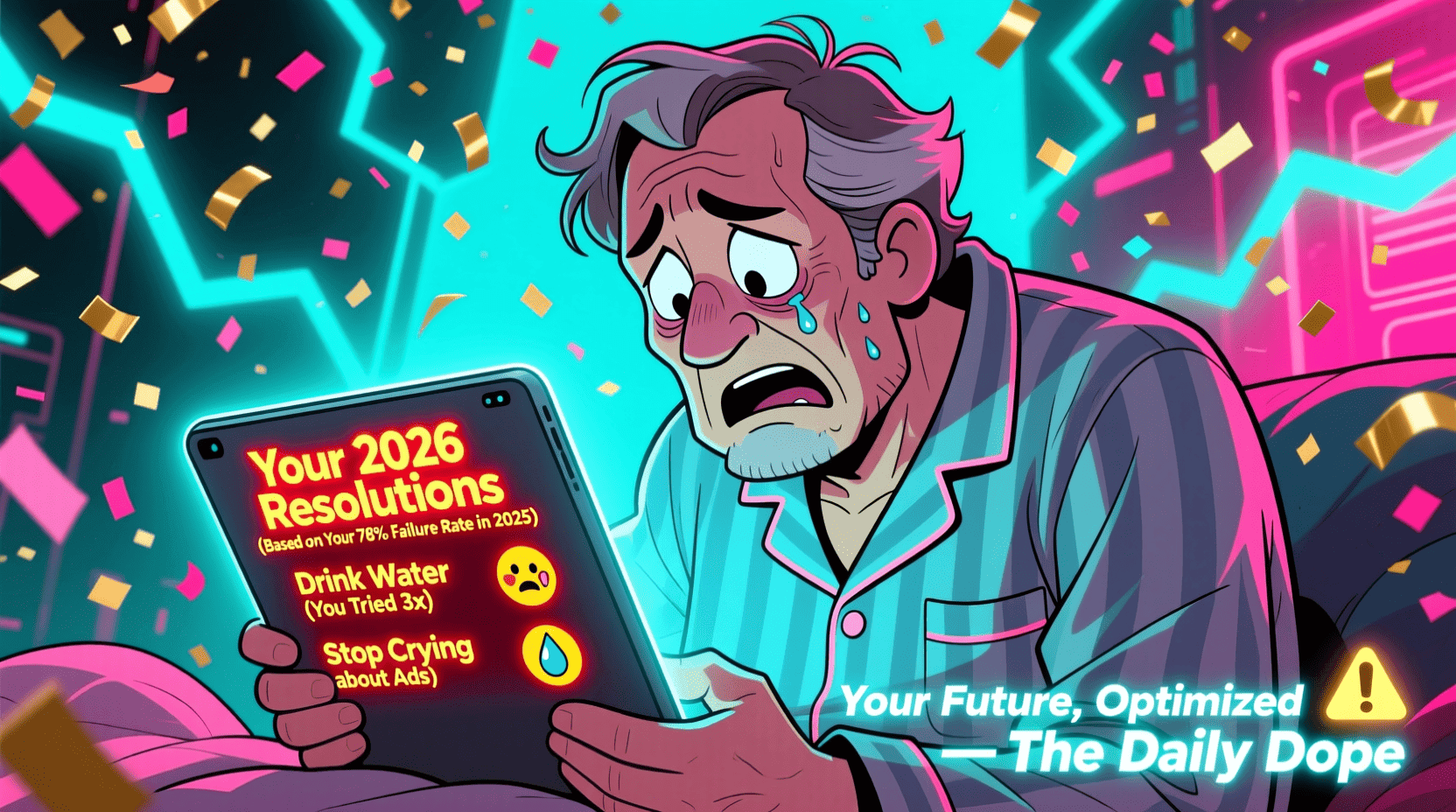
Your New Year’s resolutions just got an upgrade—for a fee. A new app, ResoMind AI, now uses your 2025 data—failed gym check-ins, abandoned meditation streaks, and that one time you cried during a toothpaste commercial—to generate “realistic, personalized resolutions” for 2026. The pitch? “We don’t want you to dream. We want you to succeed… minimally.” This isn’t self-improvement. It’s algorithmic shame with a countdown timer.
The Viral Myth of Data-Driven Hope
The promise is deceptively empowering: “Finally, resolutions that fit your actual life.” App stores call it “the end of toxic positivity.” One testimonial reads: “It told me to ‘drink water twice a week.’ I did it. I’ve never felt more accomplished.”
However, the reality is far more humiliating. Two satirical user reviews capture the mood:
“It analyzed my 2025 and suggested: ‘Stop Googling ‘am I a fraud?’ at 3 a.m.’ So for 2026, my resolution is: ‘Google it only at 2 a.m.’ Feels achievable.” — @MinimalGrowth
“My 2025 goal was ‘Read 12 books.’ I read 0. ResoMind’s 2026 suggestion: ‘Look at a book cover. Appreciate its design.’ I cried. Then marked it complete.” — @SoftLaunchHuman
Consequently, the myth—that this is progress—quickly unravels. Ultimately, it’s capitalism selling you permission to fail quietly.
The Absurd Mechanics of Algorithmic Self-Help
After syncing our calendar, fitness tracker, and search history (yes, we’re that desperate), we uncovered ResoMind’s full methodology:
- Failure Score Analysis: Rates your 2025 goals on a “Likelihood of Repeating Failure” scale (0–100%).
- Shame Calibration: Adjusts wording to avoid triggering “demotivation spikes.” Example: “Lose weight” becomes “Stand near a salad once.”
- Resolution Tiers:
- Delusional (Free): “Write a novel.”
- Realistic ($4.99/month): “Open a blank Word doc. Stare at it.”
- Existential ($14.99/month): “Accept that you’ll never read this resolution.”
Worse: the app tracks your 2026 progress in real time. Skip a “water drinking” window? It sends a passive-aggressive notification: “Your 2025 self believed in you. Your 2026 self? Less so.”
And yes—there’s merch:
– “I Only Failed 78% This Year” T-shirt
– “Certified Low-Expectations Human” enamel pin
– A $30 “Resolution Reset Kit” (includes a blank planner and a “Good Enough” stamp)
The Merchandising of Minimal Ambition
Of course, the ecosystem expands:
- **“Failure Forgiveness Insurance”**: Pay $9.99 to auto-reset your resolution count after a “moral collapse” (e.g., eating ice cream in bed).
- **“Guilt-Free Abandonment Mode”**: For $19.99, the app lets you quit without judgment—just a gentle: “You tried. We knew you wouldn’t.”
- **“2025 Autopsy Report”**: A 20-page PDF titled “Why You Failed (And Why It’s Fine).”
Hence, your self-worth becomes a tiered subscription. Therefore, you’re not lazy—you’re “optimally calibrated.”
The Reckoning: When Growth Becomes a Metric
This trend didn’t emerge in a vacuum. It’s the logical endpoint of a culture that treats personal development as data and failure as a feature.
As we explored in Calorie Counting Satire, modern life quantifies everything—even your worth. And as shown in Mastering Small Talk, even social skills are now “optimized.”
High-authority sources confirm the drift:
- American Psychological Association warns that algorithmic self-help can increase shame and reduce intrinsic motivation.
- Nielsen reports that 61% of resolution-makers abandon goals by February—but 44% keep paying for “progress tracking” apps.
- Harvard Business Review notes that “micro-goals” are often used to mask systemic burnout.
Thus, the real cost isn’t the $14.99/month. Ultimately, it’s the erasure of aspirational selfhood—where dreaming big is replaced by barely trying.
The Hidden Irony: Who Profits From Your Paralysis?
Let’s be clear: ResoMind doesn’t care about your growth. It cares about your data. By framing failure as “normal,” it keeps you subscribed—even when you’ve given up.
One former app developer admitted anonymously: “We don’t sell hope. We sell the illusion that you’re still trying. That’s way more profitable.”
And it works. Since launch, ResoMind has 2 million active users. Not because they’re succeeding—but because the app makes failure feel like a plan.
Conclusion: The Cynical Verdict
So go ahead. Let the AI write your resolutions.
Let it suggest you “breathe deeply once per quarter.”
Celebrate hitting 10% of your goal.
But don’t call it growth.
Call it surrender with better analytics.
And tomorrow? You’ll probably upgrade to “Existential Tier”…
because your dreams deserve a lower bar.
After all—in 2026, the most realistic resolution isn’t to change. It’s to stop pretending you will.
