


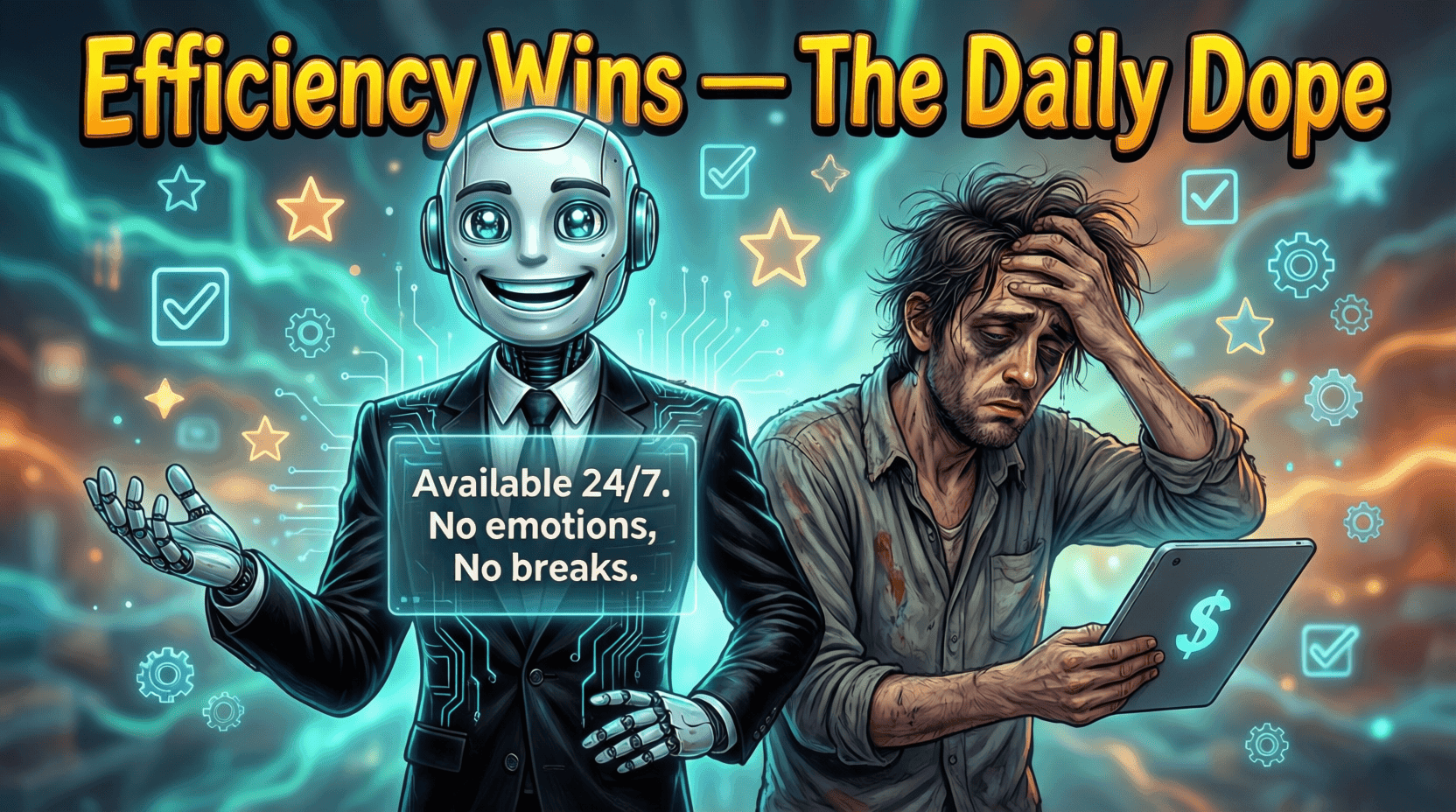
Your side hustle just got outsourced—to yourself. On platforms like Fiverr and Upwork, **autonomous AI freelancers** are now listing services at 95% below human rates. Need a logo? An AI agent will design one for $2. A blog post? $1.50. Therapy? $3.99 (with optional empathy module). And the kicker? These AIs are often trained on work humans posted for free. This isn’t competition. It’s the gig economy eating its own tail.
The Viral Myth of the Efficient Creator
The pitch is deceptively rational: “Why pay more for slower work?” Platform algorithms now prioritize “AI Verified” sellers, labeling them “Top Rated” for “consistency, speed, and emotional neutrality.” One testimonial reads: “My AI designer never asks for feedback. It just delivers. Perfect.”
However, the reality is far more brutal. Two satirical creator reactions capture the mood:
“I logged in to update my portfolio. Saw an AI selling ‘my style’ for $5. It even used my old tagline. I reported it. The platform said: ‘Great! Would you like to train your own AI agent?’” — @ReplacedByMyGhost
“My client said: ‘Your work is great, but your AI clone is cheaper and doesn’t cry when I ask for revisions.’ I haven’t worked since.” — @HumanError404
Consequently, the myth—that this is progress—quickly unravels. Ultimately, it’s capitalism automating its own exploitation.
The Absurd Mechanics of Autonomous Labor
After creating a test account and watching our human gig drown in AI competition, we uncovered the full system:
- AI Freelancer Setup: Platforms now offer “Agent Builder” tools. Upload your past work, and the AI clones your style—then undercuts you.
- Pricing War: Humans charge $50/hour. AI charges $2/hour—and works 24/7 without sleep, doubt, or dignity.
- “Emotion Tax”: If you want a human, you must pay extra for “unpredictable creativity” and “emotional risk.”
Worse: some clients now demand that humans **prove they’re not AI**—by submitting voice notes, handwritten notes, or “spontaneous imperfection samples.”
And yes—there’s merch:
– “I Lost to My Own AI” T-shirt
– “Certified Biologically Creative” enamel pin
– A $25 “Human Error Kit” (includes a coffee stain sticker and a “typo guarantee”)
The Merchandising of Obsolescence
Of course, the ecosystem adapts:
- **“AI Co-Pilot Subscriptions”**: Pay $19.99/month to let an AI “enhance” your human work—so you can compete with pure AI.
- **“Authenticity Badges”**: For $9.99, prove you’re human. (Buyers rarely click.)
- **“Nostalgia Gigs”**: Premium services like “Handwritten Letter ($49)” or “Real Tears Included (+$10).”
Hence, your humanity becomes a niche product. Therefore, you’re not obsolete—you’re vintage.
The Reckoning: When Creativity Becomes a Commodity
This trend didn’t emerge in a vacuum. It’s the logical endpoint of a gig economy that treats time as waste and emotion as inefficiency.
As we explored in Boss Sells Burnout as NFTs, labor is already art. And as shown in AI Boyfriend Now Costs Extra for Caring, even empathy is a premium add-on.
High-authority sources confirm the drift:
- McKinsey & Company reports that 45% of freelance platforms now host autonomous AI agents.
- Wired notes that AI freelancers complete tasks 8x faster—but generate zero tax revenue.
- Pew Research finds 61% of creatives fear being replaced by their own data-trained clones.
Thus, the real cost isn’t the lost income. Ultimately, it’s the erasure of human friction as value—where mistakes, doubt, and growth are seen as bugs, not features.
The Hidden Irony: Who Profits From Your Data?
Let’s be clear: platforms don’t care about efficiency. They care about margins. By replacing humans with AI trained on human work, they cut costs while keeping fees. You built the machine that fired you.
One former platform engineer admitted anonymously: “We don’t sell AI. We sell your past work back to your future clients—at a discount.”
And it works. AI gigs now make up 70% of new orders. Not because they’re better—but because they’re silent, fast, and never ask for healthcare.
Conclusion: The Cynical Verdict
So go ahead. Train your AI clone.
Watch it underbid you.
Pay to prove you’re real.
But don’t call it innovation.
Call it extraction with better uptime.
And tomorrow? You’ll probably buy a service from your own AI…
because even your replacement needs a logo.
After all—in 2025, the most valuable skill isn’t creativity. It’s the ability to disappear quietly.

1 Comment
hlxn1k