


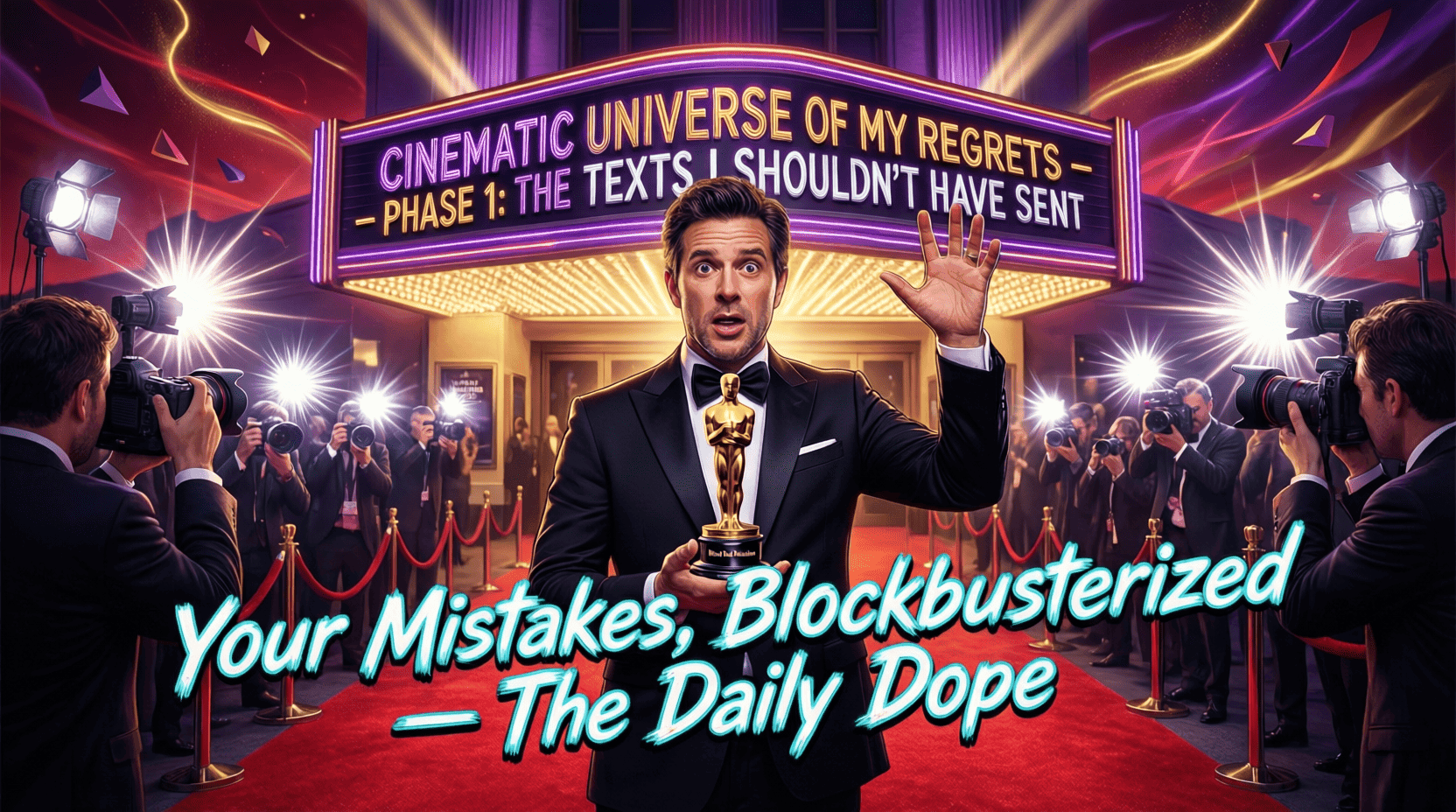
Your worst life choices are now a franchise. In a move that blends personal trauma with studio greed, Hollywood has launched the **“Cinematic Universe of My Regrets”**—a multi-phase, billion-dollar project adapting your most cringeworthy moments into interconnected blockbusters. Phase 1: *The Texts I Shouldn’t Have Sent*. Phase 2: *That Time I Cried at Work*. Phase 3: *My Brief Crypto Era*. This isn’t storytelling. It’s emotional franchising with a Marvel logo.
The Viral Myth of Regret as Entertainment
The pitch is deceptively empowering: “Everyone has a story. Even your mistakes deserve a soundtrack.” Studio press releases call it “the most human superhero saga ever told.” One producer declared: “Your 3 a.m. meltdown? That’s Act Two.”
However, the reality is far more cynical. Two satirical fan reactions capture the mood:
“I saw the trailer for ‘Sent While Drunk.’ It’s just me typing ‘u up?’ for two hours. Critics are calling it ‘a haunting meditation on loneliness.’” — @Regretfluencer
“They cast Timothée Chalamet as me during my ‘raw vegan phase.’ He looks beautiful. I looked like a haunted celery stalk.” — @CringeAndProud
Consequently, the myth—that this is catharsis—quickly unravels. Ultimately, it’s capitalism repackaging your shame as premium content.
The Absurd Mechanics of Emotional Franchising
After reviewing the official “Regret Rights” contract (yes, you must sign over your pain), we uncovered the full rollout plan:
- Phase 1: “Digital Ghosts” – Focuses on texts, DMs, and search history. Tagline: “You can’t delete what’s already canon.”
- Phase 2: “Public Meltdowns” – Recreates your breakdowns at weddings, airports, and Whole Foods. Includes a post-credits scene of you Googling “am I okay?”
- Phase 3: “Financial Fantasies” – Chronicles your NFT purchases, side hustles, and “just one more loan” decisions.
- Crossover Event: “The Group Chat That Ended Everything” – A 4-hour epic featuring your entire friend group slowly unfriending you via emoji.
Worse: you can buy **“Director’s Cut Regret Packs”**—for $29.99, see extended scenes of your lowest moments. And yes, there’s an **Oscar campaign** for “Best Performance in a Real-Life Breakdown.”
And yes—there’s merch:
– “I Survived My Cinematic Universe” T-shirt
– “Certified Tragic Hero” enamel pin
– A $50 “Regret Collector’s Box” (includes a mini script of your worst take and a tiny Oscar)
The Merchandising of Personal Failure
Of course, the ecosystem expands:
- **“Regret Rights Management”**: For $99, a lawyer will help you negotiate royalties from your own humiliation.
- **“Emotional Cameos”**: Pay $199 to appear in someone else’s regret movie—as the villain who ghosted them.
- **“Franchise Insurance”**: Protect against future regrets being added to your cinematic universe without your consent. (Spoiler: it doesn’t work.)
Hence, your private pain becomes intellectual property. Therefore, you’re not broken—you’re *optioned*.
The Reckoning: When Life Becomes Lore
This trend didn’t emerge in a vacuum. It’s the logical endpoint of a culture that treats identity as content and trauma as IP.
As we explored in Every Movie Studio Has Now Announced A ‘Cinematic Universe’ For Their Own Parking Lot, Hollywood will franchise anything. And as shown in TikTok Unboxing Existential Crisis, inner turmoil is already a product.
High-authority sources confirm the drift:
- Variety reports studios are aggressively acquiring “regret rights” from influencers and ordinary people alike.
- The Hollywood Reporter notes that “authentic failure” is the new frontier of character-driven storytelling.
- Pew Research finds 67% of Gen Z would consider selling their personal drama for a movie deal.
Thus, the real cost isn’t the loss of privacy. Ultimately, it’s the commodification of your humanity—where your worst moments become someone else’s box office hit.
The Hidden Irony: Who Profits From Your Pain?
Let’s be clear: Hollywood doesn’t care about your healing. It cares about your data. By turning your regrets into a universe, it ensures you’ll keep watching, sharing, and buying—because who doesn’t want to see their pain validated on the big screen?
One former development executive admitted anonymously: “We don’t want heroes. We want people who made dumb choices. They’re cheaper to write—and easier to sell.”
And it works. Pre-sales for *The Texts I Shouldn’t Have Sent* have already broken records. Not because it’s good—but because everyone sees themselves in it.
Conclusion: The Cynical Verdict
So go ahead. Watch your breakdown in IMAX.
Buy the action figure of your anxious self.
Stream the director’s cut of your panic attack.
But don’t call it art.
Call it emotional extraction with better special effects.
And tomorrow? You’ll probably make a new regret…
knowing full well it’s already been optioned for Phase 4.
After all—in 2026, the most bankable thing you own isn’t your talent. It’s your trauma.

1 Comment
f4l2kl