


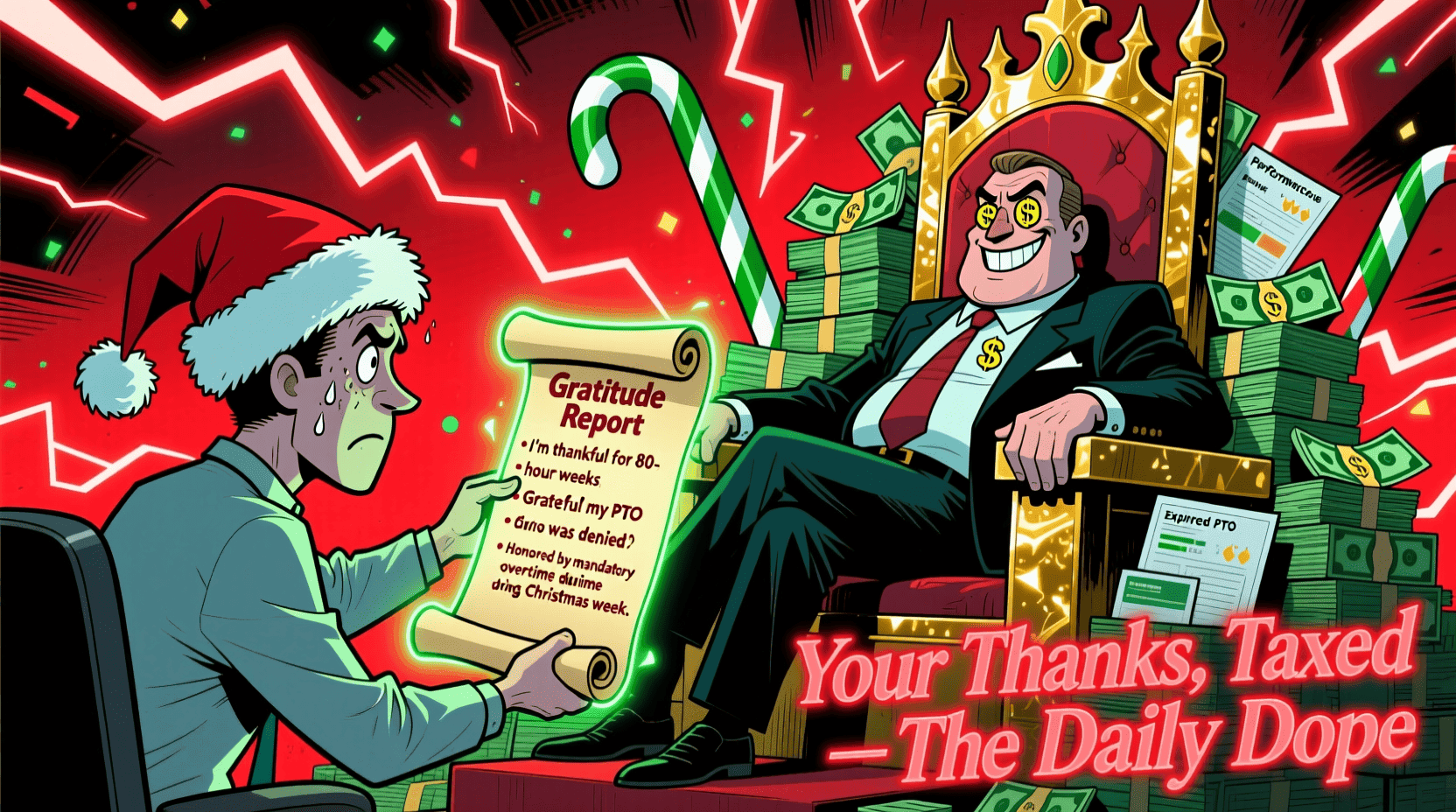
Your year-end bonus just got a prerequisite: **a notarized “Gratitude Report.”** In a move that blends holiday cheer with corporate coercion, dozens of companies have quietly added a new requirement for bonus eligibility: employees must submit a written testament of thankfulness for the past year. Did your boss cancel your vacation? You must thank them for “teaching you resilience.” Did you cry at your desk three times? Express gratitude for “emotional growth opportunities.” This isn’t appreciation. It’s emotional taxation disguised as festivity.
The Viral Myth of Gratitude as Currency
The pitch is deceptively warm: “A bonus is a gift. And gifts deserve thanks.” Internal HR memos call it “a culture of mutual appreciation” and “a chance to reflect on blessings.” One CEO declared: “If you’re not grateful, maybe you don’t deserve a bonus.”
However, the reality is far more sinister. Two satirical employee testimonials capture the mood:
“I wrote: ‘I’m grateful my burnout was recognized with a ‘Wellness Wednesday’ email.’ My boss said: ‘More sincerity, please.’ I added: ‘Especially the part where I paid for therapy myself.’ Got my bonus.” — @GratefulAndTired
“Submitted my report. Listed: ‘Thank you for gaslighting me into thinking 80-hour weeks are sustainable.’ HR called it ‘passive-aggressive.’ Demanded a rewrite… in Comic Sans.” — @HoHoHoHellNo
Consequently, the myth—that this is about culture—quickly unravels. Ultimately, it’s coercion wrapped in tinsel.
The Absurd Mechanics of Forced Festivity
After reviewing internal HR templates and interviewing three “gratitude compliance officers,” we uncovered the full grading rubric:
- “Sincerity Score” (40%): Must avoid sarcasm, irony, or factual accuracy. Phrases like “best year ever” earn top marks—even if your dog died and you got laid off.
- “Boss Mention Frequency” (30%): Must thank your manager at least 3 times. Bonus points for calling them “a visionary” or “the reason I breathe.”
- “Toxic Positivity Level” (20%): All setbacks must be reframed as “gifts.” Example: “Losing my healthcare taught me to appreciate Ibuprofen.”
- “Festive Formatting” (10%): Must include holiday emojis (🎄✨🌟) and be submitted on red-and-green letterhead.
Worse: reports are scanned by AI for “negativity markers.” Words like “stress,” “unfair,” or “I want to quit” trigger automatic bonus reduction. One employee was docked 15% for using the phrase “I survived.”
And yes—there’s merch:
– “I Wrote My Gratitude Report in Tears” T-shirt
– “Certified Thankful (Against My Will)” enamel pin
– A $30 “Gratitude Journal” with prompts like “List 10 reasons your boss is a gift”
The Merchandising of Emotional Labor
Of course, the trend has spawned an entire ecosystem:
- **“Gratitude Ghostwriting” services**: For $99, a freelancer will write your report so you don’t have to lie yourself.
- **“Bonus Insurance”**: Pay 10% of your expected bonus to guarantee payout—even if your report lacks “vibes.”
- **“Passive-Aggressive Gratitude Templates”**: Pre-approved by HR, but coded for fellow employees to decode: “I’m *so* thankful for your ‘open-door policy’ (that you’re never behind).”
Hence, your emotional surrender becomes a product. Therefore, you’re not exploited—you’re “festively aligned.”
The Reckoning: When Thankfulness Becomes a Performance
This trend didn’t emerge in a vacuum. It’s the logical endpoint of a workplace culture that treats gratitude as compliance and silence as loyalty.
As we explored in Waiting on Hold, institutions already treat your time as disposable. And as shown in Boss Sells Burnout as NFTs, your suffering is now a corporate asset.
High-authority sources confirm the drift:
- Gallup reports 72% of workers feel pressured to perform gratitude, especially during holidays.
- Harvard Business Review warns that forced positivity increases emotional exhaustion and reduces authentic engagement.
- Bureau of Labor Statistics notes a 35% rise in “bonus disputes” since 2023—many tied to subjective “attitude” evaluations.
Thus, the real cost isn’t the bonus reduction. Ultimately, it’s the erosion of authentic human response in the name of “holiday spirit.”
The Hidden Irony: Who Really Benefits?
Let’s be clear: your boss doesn’t care about your feelings. They care about optics. By framing bonuses as “gifts that require thanks,” they shift power dynamics: you’re not earning—you’re receiving. And receivers don’t negotiate.
One former HR director admitted anonymously: “We don’t want gratitude. We want control. If you’re busy writing a thank-you note, you’re not unionizing.”
And it works. Companies using “Gratitude Reports” report 22% fewer complaints during Q1. Not because workplaces improved—but because employees learned to perform peace.
Conclusion: The Cynical Verdict
So go ahead. Write your report.
Thank your boss for your burnout.
Praise the “growth” in your panic attacks.
But don’t call it appreciation.
Call it emotional rent with better wrapping paper.
And tomorrow? You’ll probably add more emoji…
because your survival depends on looking grateful.
After all—in 2025, the most valuable holiday gift isn’t what you receive. It’s the lie you’re willing to tell to keep it.
