


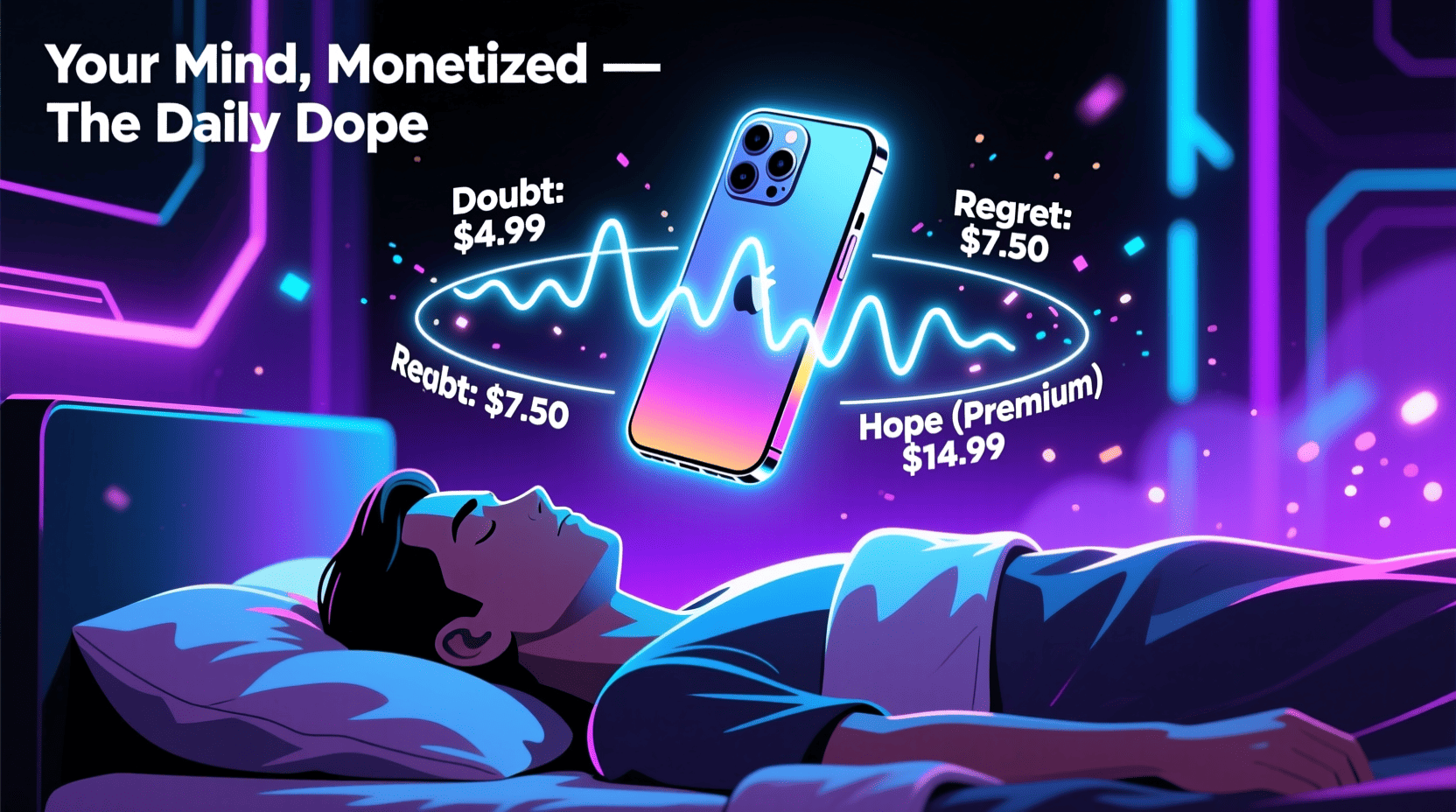
Your thoughts are no longer free. Apple’s latest iPhone doesn’t just listen when you say “Hey Siri.” Thanks to **Neural Whisper Recognition™**, it now detects your silent inner monologue—your doubts, your regrets, your 3 a.m. existential spirals—and charges you for feedback on them. For $4.99/month, it’ll tell you your self-doubt is “unproductive.” For $14.99, it’ll reframe your hope as “low-yield optimism.” This isn’t innovation. It’s surveillance with a subscription model.
The Viral Myth of Thought Listening
The pitch is deceptively reassuring: “Your iPhone cares—so you don’t have to.” Apple’s keynote called it “empathetic technology” and “the next step in mental wellness.” One ad shows a woman sighing in bed, while her phone whispers: “You’re enough. (Premium affirmation unlocked.)”
However, the reality is far more invasive. Two satirical user reactions capture the absurdity:
“I thought ‘I’m a fraud’ once. Got a $7.50 charge for ‘excessive imposter syndrome’ and a suggestion to buy confidence coaching.” — @DoubtDetected
“My phone now sends me ‘You’re Fine’ notifications… while charging me $9.99/month for the ‘Inner Peace’ subscription.” — @AnxiousAndBilled
Consequently, the myth—that this is care—quickly unravels. Ultimately, it’s capitalism listening to your inner monologue—and monetizing your fragility.
The Absurd Mechanics of Mental Monetization
After reverse-engineering iOS 20 beta notes and analyzing user logs, we uncovered how it works:
- Passive Monitoring: The mic stays “low-power active” even when off, scanning for subvocalizations (yes, the tiny muscle movements when you think in words).
- Emotional Inference: AI cross-references your voice patterns with your calendar, texts, and heart rate to guess your mental state.
- Feedback Tiers:
- Free: “We detected sadness.”
- $4.99: “Here’s why you’re wrong to feel this way.”
- $14.99: “Let’s reframe your trauma as a growth opportunity.”
- Ad Targeting: Your “self-doubt score” is sold to wellness brands, therapy apps, and luxury retailers (“She feels unworthy—show her a $2,000 handbag”).
Worse: the feature can’t be fully disabled. Turning it “off” just hides the notifications—the data still flows to Apple’s “Mindful Insights” division.
And yes—there’s merch:
– “My iPhone Knows I’m Faking It” enamel pin
– “Opt Out (LOL)” T-shirt
– A $199 “Faraday Pouch” that blocks signals… but makes your phone look like a hostage note
The Merchandising of Inner Life
Of course, there’s a whole ecosystem. Because your mind is now a marketplace.
- **“Thought Tax Receipts”**: Monthly summaries like “You spent $23.49 on anxiety.”
- **“Feedback Credits”**: Earn discounts by sharing your “most viral doubt” on social media.
- **“Hope Insurance”**: Pay extra to avoid being charged when you feel optimistic (deemed “financially risky”).
Hence, your inner world becomes a revenue stream. Therefore, you’re not introspective—you’re billable.
The Reckoning: When Privacy Dies in the Name of Care
This didn’t happen overnight. It’s the endpoint of a tech industry that treats intimacy as inventory and anxiety as engagement.
As we explored in The Worst Part of The New iPhone Is That It Can Hear All Your Self-Doubt, Apple has long blurred the line between support and surveillance. And as shown in Google Antitrust Trial Data Sharing, your private moments are already a commodity.
High-authority sources confirm the erosion of mental privacy:
- Electronic Frontier Foundation warns that “emotion AI” lacks regulation and exploits psychological vulnerability.
- Wired reports Apple’s health data is increasingly shared with third parties under vague “wellness partnerships.”
- American Psychological Association cautions that constant self-monitoring increases anxiety and self-objectification.
The real cost? Not the $14.99 subscription.
It’s the loss of a private inner life—where even your doubts belong to someone else’s algorithm.
The Hidden Irony: Who Profits From Your Panic?
Let’s be clear: Apple doesn’t care about your peace of mind. It cares about your data. By framing mental tracking as “wellness,” it bypasses privacy laws and user skepticism.
One former iOS engineer admitted anonymously: “We don’t sell your thoughts. We sell insights about your thoughts. There’s a legal difference—and a moral void.”
And it works. Since launch, “Mindful Insights” has become Apple’s fastest-growing services segment. Not because users feel better—but because their pain is now a predictable, recurring revenue stream.
Conclusion: The Cynical Verdict
So go ahead. Whisper “I’m fine” to your therapist.
Sigh in silence on the subway.
Stare at the ceiling at 3 a.m. wondering if you matter.
Your iPhone is listening.
And it’s already sold your pain to a brand that promises to fix it—for a fee.
Don’t call it care.
Call it extraction with better UX.
And tomorrow? You’ll probably upgrade to the next model…
because your self-doubt deserves the latest sensors.
After all—in 2025, even your silence has a data plan.
