


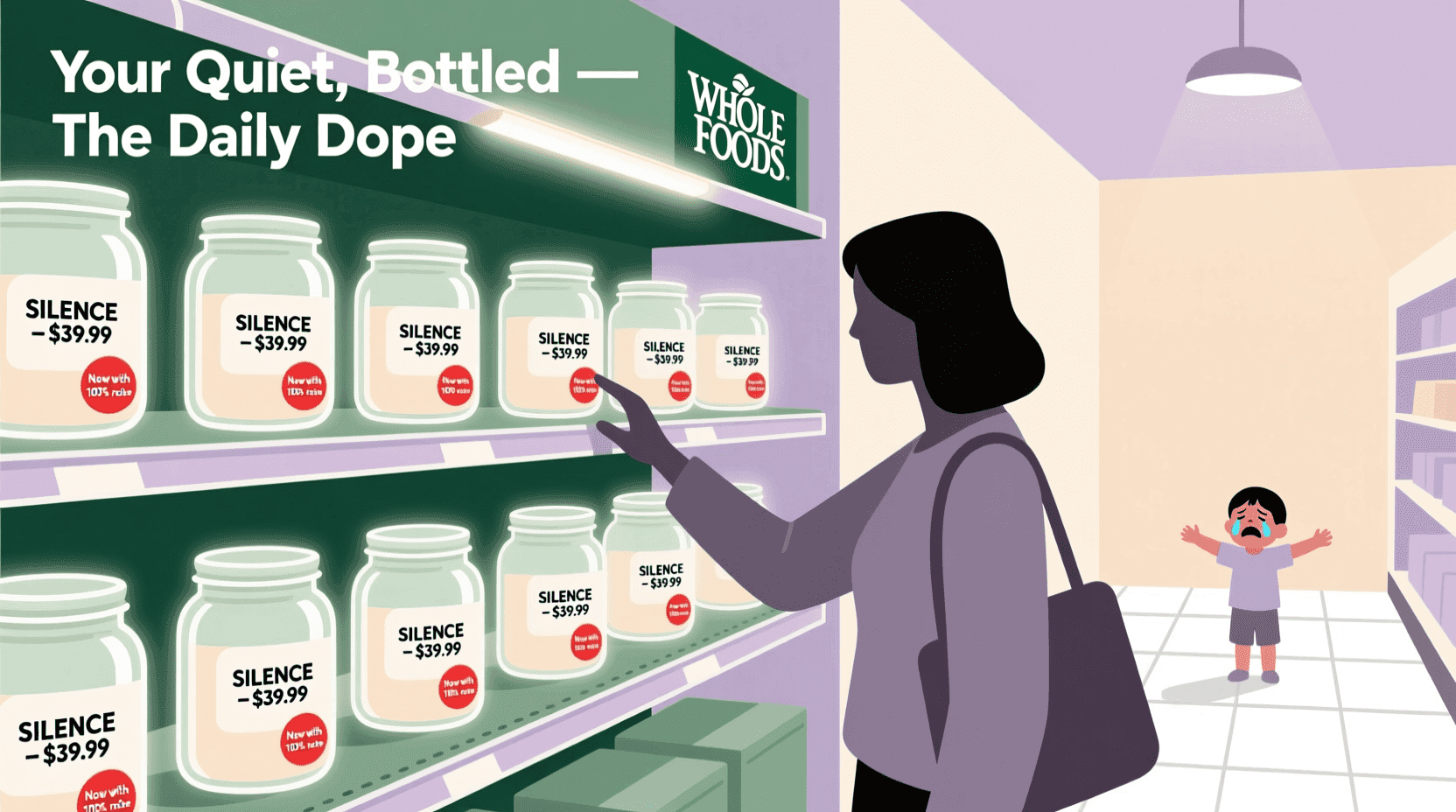
Whole Foods doesn’t just sell groceries anymore—it sells the absence of sound. The retailer has quietly launched **“Silence”**—a premium wellness product marketed as “pure acoustic emptiness in a recyclable jar.” Priced at $39.99, it comes with no physical contents, only a QR code that plays 10 minutes of “curated quiet” and a certificate of “auditory detox.” This isn’t innovation. It’s the ultimate expression of spiritual consumerism: paying to escape the noise you helped create.
The Viral Myth of Bottled Quiet
The pitch is deceptively serene: “In a world of constant noise, silence is the ultimate luxury.” In-store signage calls it “a moment of stillness you can take home.” One tagline reads: “Your mind deserves peace. Your wallet can handle it.”
However, the reality is far more absurd. Two satirical customer reactions capture the mood:
“I bought ‘Silence’ for my meditation corner. My neighbor’s dog barked. The app refunded me 0.3 seconds of quiet. I felt seen.” — @QuietlyBroke
“It’s just an empty jar with a $40 label. But when I hold it, I feel… spiritually minimalist.” — @ZenAndOvercharged
Consequently, the myth—that this is self-care—quickly unravels. Ultimately, it’s capitalism selling you the right to opt out of the chaos capitalism created.
The Absurd Mechanics of Acoustic Commodification
After purchasing the “Silence” jar (yes, we paid $39.99 to feel nothing), we uncovered the full experience:
- The Jar: Made of “ethically sourced glass,” but contains only air and existential dread.
- The App: Scans the QR code to play “Curated Quiet™”—10 minutes of wind, distant rain, and one barely audible sigh.
- The Certificate: “Certifies your participation in the Global Quiet Movement.” (No such movement exists.)
- The Upgrade: For $19.99/month, “Silence+” offers personalized quiet based on your noise trauma (e.g., “Toddler Yelling,” “Zoom Meeting Echo”).
Worse: the app tracks your “quiet consumption.” Miss a session? You get a gentle nudge: “Your inner peace is expiring. Renew now.”
Furthermore, Whole Foods sells “Silence Pairings”:
– “Silence + Kale Chips” ($54.99)
– “Silence + $8 Cold Brew” ($47.99)
– “Silence + Therapy You Can’t Afford” ($39.99… just the card, not the session)
The Merchandising of Absence
Of course, there’s merch. Because even nothingness needs branding.
- “I Paid $40 for Quiet and All I Got Was This T-Shirt”
- “Certified Silence Seeker” enamel pin
- A $30 “Minimalist Noise Journal” (blank pages titled “What I Didn’t Hear Today”)
Hence, your desire for peace becomes a product. Therefore, you’re not overwhelmed—you’re under-silenced.
The Reckoning: When Quiet Becomes a Luxury Good
This product didn’t emerge in a vacuum. It’s the logical endpoint of a culture that treats mental peace as a commodity and overstimulation as inevitable.
As we explored in Whole Foods Silent Sigh Kale Smoothie, the brand now sells emotional states as consumables. And as shown in Zara Quiet Poverty Collection, even struggle is aestheticized and priced.
High-authority sources confirm the trend:
- NPR reports that “premium wellness” spending has surged 200% since 2022, even as real wages stagnate.
- American Psychological Association warns that spiritual consumerism can delay real mental health care by offering symbolic solutions.
- Pew Research finds that 58% of adults say they “can’t find quiet” in daily life—yet only 12% can afford retreats or soundproofing.
Thus, the real cost isn’t the $39.99. Ultimately, it’s the normalization of peace as a privilege—where silence is no longer a right, but a SKU.
The Hidden Irony: Who Really Benefits?
Let’s be clear: Whole Foods doesn’t care about your inner calm. It cares about your credit limit. By framing noise pollution as a personal problem, it shifts blame from systemic overstimulation (ads, social media, urban design) to individual coping.
One former wellness buyer admitted anonymously: “We don’t sell silence. We sell the feeling that you’ve done something about the noise. That’s easier—and more profitable—than fixing it.”
And it works. Since launch, “Silence” has become Whole Foods’ fastest-selling non-edible item. Not because the world is quieter—but because people are desperate enough to pay for the illusion of quiet.
Conclusion: The Cynical Verdict
So go ahead. Buy the jar.
Scan the code.
Close your eyes as distant rain plays through your AirPods.
But don’t call it peace.
Call it capitalism with better acoustics.
And tomorrow? You’ll probably subscribe to “Silence+”…
because your silence deserves an upgrade.
After all—in 2025, the most expensive thing in the store isn’t truffle oil. It’s the absence of sound.
