


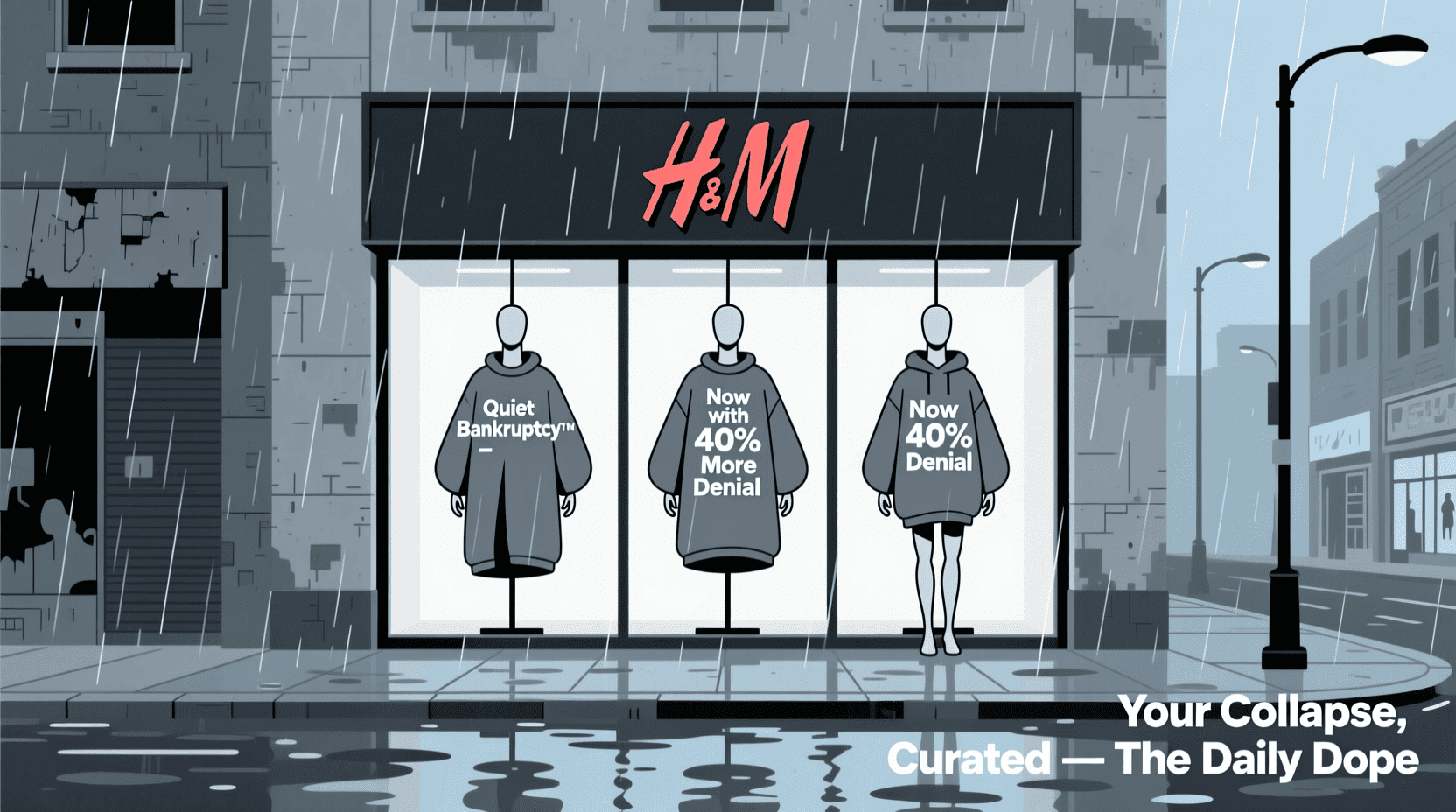
H&M doesn’t just sell fast fashion anymore—it sells the aesthetic of financial surrender. The retailer has quietly launched its new **“Quiet Bankruptcy” collection**, a line of oversized gray sweaters, frayed-hem trousers, and “utility” tote bags labeled “Emergency Fund (Depleted).” Priced at $39–$79, the collection promises “effortless minimalism for the economically exhausted.” This isn’t style. It’s poverty-core with a barcode.
The Viral Myth of Quiet Bankruptcy
The pitch is deceptively serene: “Less is more. Especially when your bank account agrees.” Marketing materials feature models staring blankly out rainy windows, holding coffee cups labeled “Last $3.” One tagline reads: “Dress like you’ve accepted your overdraft.”
However, the reality is far less poetic. Two satirical customer reactions capture the absurdity:
“Bought the ‘Rent Overdue’ cardigan. My landlord said it’s ‘on brand.’ I cried. Then posted it on TikTok with #QuietBankruptcy.” — @BrokeAndStyled
“The ‘Credit Limit Reached’ pants have fake tear stains. I asked if they’re washable. They said: ‘Only with hope—and hope is out of stock.’” — @MinimalistInDebt
Consequently, the myth—that this is anti-consumerism—quickly unravels. Ultimately, it’s capitalism selling you the look of having opted out of capitalism.
The Absurd Mechanics of Financial Aesthetic
After visiting three H&M locations and analyzing the “Quiet Bankruptcy” lookbook, we uncovered the full philosophy:
- “Gray of Denial” Sweater ($49) – 100% recycled polyester, 0% financial security.
- “Quiet Desperation” Tote ($29) – Fits a résumé, a collection notice, and one expired coupon.
- “Gig Economy Gray” Trousers ($59) – Wrinkle-resistant, like your soul after your third side hustle.
- “Hope Deferred” Scarf ($19) – Comes with a QR code to a meditation on “delayed solvency.”
Each item includes a “Financial Story Card” with fictional backstories like: “This sweater was inspired by a woman who chose groceries over her car payment.”
Furthermore, the collection is marketed as “sustainable”—not because it lasts, but because it reflects the “sustainable lifestyle of doing without.”
The Merchandising of Economic Surrender
Of course, there’s merch. Because no retail absurdity is complete without a branded coping mechanism.
- “I Can’t Afford This But I Bought It” T-shirt
- “Certified Quiet Poor” enamel pin
- A $25 “Minimalist Budgeting” journal (mostly blank pages titled “Expenses I Can’t Avoid”)
Hence, even your financial collapse becomes a lifestyle choice. Therefore, you’re not broke—you’re curated.
The Reckoning: When Struggle Becomes Style
This trend didn’t emerge in a vacuum. It’s the logical endpoint of a culture that treats precarity as personality and resignation as refinement.
As we explored in Zara Quiet Poverty Collection, fast fashion increasingly aestheticizes economic anxiety. Similarly, as shown in Airbnb Storage Units Vacation, survival is now sold as design.
High-authority sources confirm the drift:
- Vogue reports “quiet bankruptcy” is emerging as a 2025 micro-trend—despite 45% of Americans having less than $1,000 in savings.
- Brookings Institution warns that aestheticizing poverty distracts from systemic inequality and normalizes financial instability.
- Pew Research finds 61% of Gen Z say they “dress broke” even when they’re not—because it’s perceived as “authentic” and “grounded.”
Thus, the real cost isn’t the $59 trousers. Ultimately, it’s the normalization of financial fragility as identity—while real poverty remains unglamorous, invisible, and unprofitable.
The Hidden Irony: Who Profits From Your Panic?
Let’s be clear: H&M doesn’t care about your overdraft. It cares about your wallet. By framing economic anxiety as a fashion statement, it turns your stress into a sales channel.
One former retail strategist, speaking anonymously, admitted: “We don’t sell clothes to the poor. We sell the *idea* of being poor to the anxious middle class. They’ll pay $50 to feel ‘real’—even if they’re not actually struggling.”
And it works. Since launch, “Quiet Bankruptcy” has become H&M’s fastest-selling capsule collection in urban markets. Not because people are broke—but because they’re terrified of becoming it.
Conclusion: The Cynical Verdict
So go ahead. Buy the “Rent Overdue” cardigan.
Pair it with “Credit Limit Reached” pants.
Post your #QuietBankruptcy fit on Instagram.
But don’t call it rebellion.
Call it capitalism with better tailoring.
And tomorrow? You’ll probably max out your credit card…
because your despair deserves a designer label.
After all—in 2025, the most elite look isn’t wealth. It’s the illusion of having gracefully accepted your financial doom.

2 Comments
n7iqvy
Pingback: zara drops quiet despair collection in beige regret