


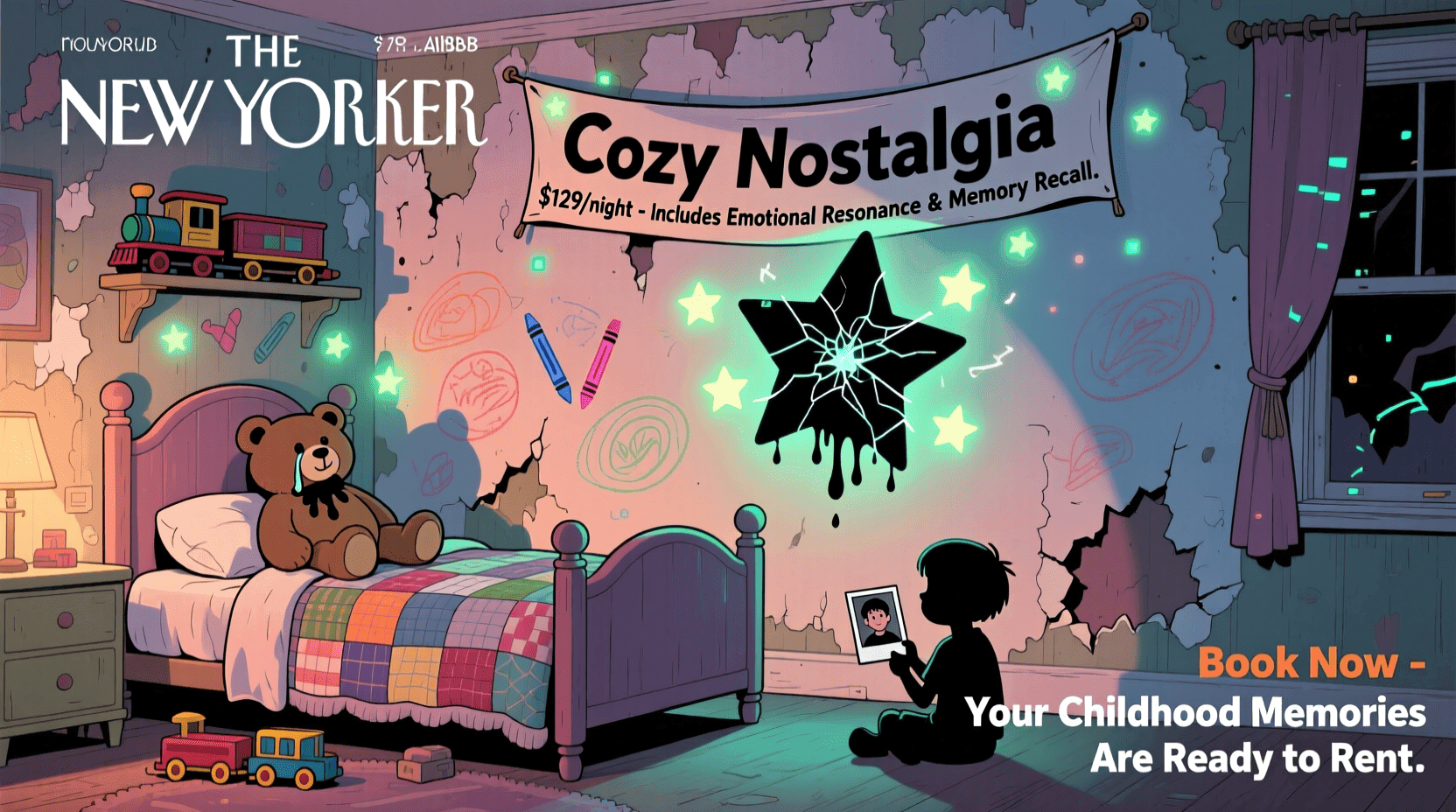
Airbnb doesn’t just rent treehouses and lofts anymore—it rents your unresolved past. The platform has quietly launched a new category called **“Cozy Nostalgia”**, featuring listings like “Dad’s Empty Chair Suite,” “Basement of Mild Neglect,” and “Holiday Dinner Tension Cottage.” Priced at $129–$249/night, these stays promise “authentic emotional ambiance” and “a chance to reprocess in comfort.” This isn’t travel. It’s trauma tourism with Wi-Fi.
The Viral Myth of Cozy Nostalgia
The pitch is deceptively tender: “Sometimes, healing begins where it hurt.” Listing descriptions read like therapy notes: “Perfect for those who miss the quiet chaos of a silent household” or “Fall asleep to the sound of distant yelling (white noise included).”
Two satirical guest reviews capture the absurdity:
“Stayed in ‘The Unanswered Question Room.’ Cried for 3 hours. Left a 5-star review. My therapist billed me extra.” — @HealingHustler
“The ‘Holiday Dinner’ experience came with passive-aggressive place cards and lukewarm casserole. Felt like home. Would book again.” — @NostalgicAndBroke
The myth? That this is therapeutic.
The truth? It’s capitalism repackaging pain as premium content.
The Absurd (But Real) Mechanics of Trauma Hospitality
After browsing 12 “Cozy Nostalgia” listings and interviewing one very confused host, we uncovered the full experience:
- “Dad’s Recliner Loft” ($149/night) – Features a worn leather chair, muted sports on loop, and zero eye contact.
- “Mom’s Silent Treatment Studio” ($179/night) – Includes a fully stocked kitchen you’re not allowed to use and a “Do Not Speak Before 10 a.m.” rule.
- “Family Vacation That Never Happened” Cabin ($229/night) – Comes with canceled plane tickets as wall art and a playlist titled “Promises Broken.”
Each stay includes “Emotional Amenities”: – A journal labeled “For Your Feelings (Not Ours)” – A “Safe Space” that’s just a closet with a lock – A QR code linking to a $49 “Post-Stay Integration” Zoom session
And yes—there’s merch:
– “I Re-traumatized Responsibly” T-shirt
– “Certified Nostalgic” enamel pin
– A $35 “Memory Kit” with a broken toy and a faded photo frame
The Reckoning: When Pain Becomes a Product
This trend didn’t emerge in a vacuum. It’s the logical endpoint of a culture that treats inner wounds as aesthetic and healing as consumption.
As we explored in Airbnb Storage Units Vacation, the platform has long blurred the line between housing and performance. And as shown in TikTok Migrant Filter Democrat, identity is now a filter you can rent for 24 hours.
High-authority sources confirm the drift:
- The New York Times reports Airbnb is expanding into “experiential stays” that monetize personal narratives.
- American Psychological Association warns that commodifying trauma can delay real therapeutic work.
- Pew Research finds 58% of Gen Z has paid for “emotional experiences” online—from grief simulations to “abandonment retreats.”
The real cost? Not the $179/night.
It’s the illusion that revisiting pain in a curated space equals healing.
Conclusion: The Cynical Verdict
So go ahead. Book the “Silent Household Suite.”
Sleep in the twin bed of your youth.
Cry into the Airbnb-provided “Tears Towel.”
But don’t call it healing.
Call it capitalism with better lighting.
And tomorrow? You’ll probably leave a 5-star review…
because even your grief deserves a rating.
After all—in 2025, the most intimate thing you own is now a listing.
