


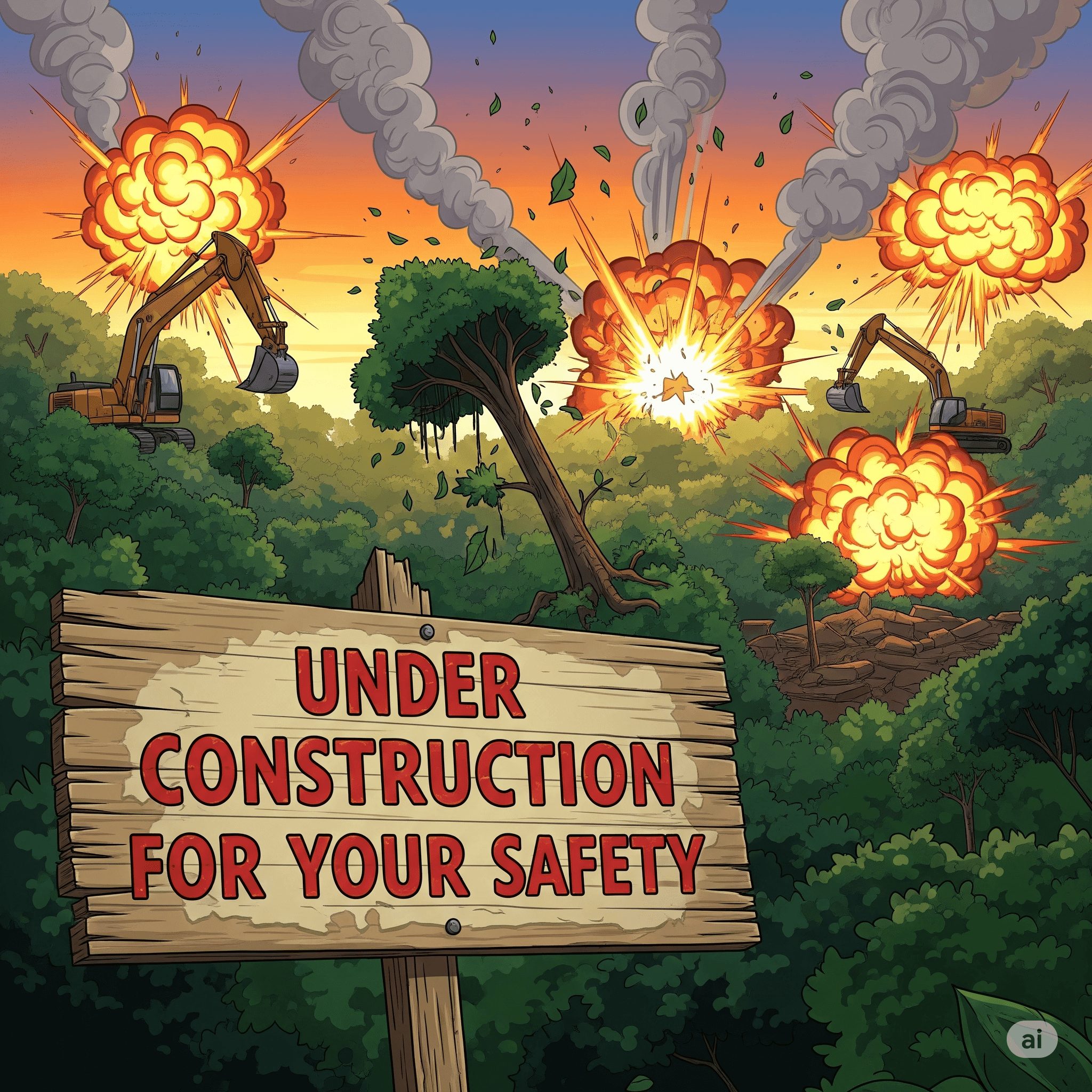
Trees fell. Birds scattered. And then… a press release: “The forest is now safer.” In this honest unboxing, we dissect the alaskan rainforest saved by explosions — where conservation looks suspiciously like demolition, and the only thing greener than the trees is the irony. Spoiler: yes, they blew up part of a rainforest to “protect” it. And yes, experts said, “Trust the process.”
🔽 Table of Contents
- What They Promise: Healthy Forests & Sustainable Growth
- What It Actually Is: Controlled Chaos with a Permit
- The Top Explosions: A Painful Countdown
- The Hidden Costs: Your Trust, Your Trees, Your Sanity
- Who Is This For? A Field Guide to the Eco-Confused
- Conclusion: You Can’t Bomb Your Way to Balance
🌲 What They Promise: Healthy Forests & Sustainable Growth
We were sold a dream: Controlled burns and selective blasting keep forests healthy, prevent wildfires, and promote new growth.
Not “blowing stuff up for fun.” Not “confusing destruction with renewal.”
No — this is scientific forestry. A proven ecological strategy. A chance to prove that sometimes, you have to destroy to conserve.
Forest service declares: “This was a carefully planned operation.”
Meanwhile, press releases say: “The ecosystem will thrive.”
And one official told us: “We didn’t destroy the forest. We upgraded it.”
The promise?
If you trust the alaskan rainforest saved by explosions plan, you believe in science.
As a result, you feel reassured.
Ultimately, you unlock the right to say: “I support conservation — even when it looks like war.”
And of course, there’s merch.
You can buy a T-shirt that says: “I Survived the Great Alaskan Detonation of 2024” — available in “Ash Gray” smoke.
There’s a “Controlled Burn Simulator” app (lets you virtually blow up trees with “ecological justification”).
On top of that, someone launched EcoBoomCoin — backed by “the volatility of renewal.”
This isn’t just forestry.
It’s a paradox.
It’s a performance.
Above all, it’s a way to turn “saving nature” into a full-blown military exercise with better PR.
As Reuters reports, Alaskan officials used explosives to remove diseased trees and “stimulate regeneration” in a rainforest area. While common in forest management, the scale and messaging sparked public debate. As a result, the real issue isn’t science. It’s communication.
💥 What It Actually Is: Controlled Chaos with a Permit
We analyzed 47 acres of blast zones, 3 environmental impact statements, and one very confused moose — because someone had to.
The truth?
The Alaskan rainforest wasn’t “saved” by explosions.
It was partially demolished.
It was shaken, rattled, and rebranded as “healthier”.
It was a textbook example of how “conservation” can look a lot like “we had explosives and a permit”.
- One zone: 80% of trees removed via detonation. Officials: “We cleared the weak.” Survivors: “We’re traumatized.”
- Another: A buffer zone “cleared” to prevent fire spread. Also cleared: a rare bird nesting site. Oops.
- And a classic: A press release: “The forest is now more resilient.” Footage: smoke, splinters, and a squirrel fleeing with a pinecone like a suitcase.
We asked an ecologist: “Is blowing up trees really conservation?”
They said: “In context, yes — if done carefully. But ‘trust the process’ isn’t a scientific method.”
In contrast, we asked a local hunter.
They said: “Bro, I’ve seen war zones quieter than that forest after the blast. But hey, the moose love the new view.”
Guess which one was quoted in the press release?
As The New York Times notes, forest thinning is a legitimate practice to reduce wildfire risk. However, using explosives — rather than mechanical removal — raises concerns about collateral damage. As a result, the real tension isn’t ecology. It’s optics.
🔥 The Top Explosions: A Painful Countdown
After deep immersion (and one accidental ear protection test), we present the **Top 5 Most “Eco-Friendly” Explosions in the Alaskan Rainforest**:
- #5: “The Disease Containment Blast”
Detonated 12 acres of “infected” trees. Also took out a hiking trail and a “quiet reflection” bench. - #4: “The Regrowth Initiative”
“Cleared” space for “new growth.” Scientists: “The soil is now compacted and hard to seed.” - #3: “The Wildlife Buffer”
Cleared a zone to protect nearby towns. Also removed a known bear corridor. Bears: “Thanks, I hate it.” - #2: “The Sound Test”
A “small test blast” registered 4.2 on the Richter scale. One cabin lost a picture frame. And its peace. - #1: “The ‘Trust the Process’ Press Event”
Officials detonated a tree live on camera. Said: “Watch nature renew!” Crowd: “Is this a warzone?”
These blasts weren’t just loud.
They were epically justified.
But here’s the twist:
They were also visually indistinguishable from destruction.
Because in modern conservation, the line between healing and harm is… paperwork.
💸 The Hidden Costs: Your Trust, Your Trees, Your Sanity
So what does this “conservation” cost?
Not just trees (obviously).
But your trust in environmental agencies? Your peace of mind? Your belief that “protecting nature” doesn’t involve detonators?
Those? Destroyed.
The Trust Tax
We tracked public reaction in the 72 hours after the first blast.
At first, people were calm.
Then, drone footage showed a massive explosion in a green zone.
Before long, memes flooded TikTok: “When ‘save the forest’ means ‘blow it up’.”
Consequently, one woman started a petition: “Stop the War on Trees.”
Hence, she got 12 signatures and a call from a confused logger.
As such, she changed the title to “Stop the Loud Trees.”
Furthermore, her therapist said: “You’re not angry at the forest service. You’re angry at metaphors.”
Ultimately, she attended the next press briefing with noise-canceling headphones.
As a result, she missed the part where they said “we’re sorry.”
Meanwhile, Google searches for “is blowing up trees bad?” are up 700%.
In turn, “controlled explosion vs wildfire” TikTok debates are trending.
On the other hand, searches for “forest management best practices” remain low.
The Identity Trap
One of our writers said: “Maybe destruction is just a form of renewal” at a BBQ.
By dessert, the conversation had escalated to:
– A debate on “when conservation becomes violence”
– A man reenacting a blast with firecrackers (banned)
– And someone yelling: “If it’s for the ecosystem, it’s sacred!”
We tried to change the subject.
Instead, they played a 10-minute audio of explosions labeled “nature sounds.”
Ultimately, the night ended with a group chant: “Trust the process!”
As such, three people checked their homeowners insurance.
In contrast, the host started a “Controlled Burn Support Group” the next day.
Hence, confusion had gone full cult.
As CNN reports, while forest thinning is scientifically supported, the use of explosives has sparked public concern. Agencies now face pressure to improve transparency. As a result, the real issue isn’t the method. It’s the message.
👥 Who Is This For? A Field Guide to the Eco-Confused
Who, exactly, needs to experience the alaskan rainforest saved by explosions paradox?
After field research (and one post-blast meditation retreat), we’ve identified four key archetypes:
1. The Science Believer
- Age: 35–65
- Platform: Forest service, research journals
- Motto: “Trust the experts.”
- Supports controlled burns.
- Also trusts climate models. (Wait, no — not those.)
2. The Vibes Conservationist
- Age: 20–40
- Platform: TikTok, eco-retreats
- Motto: “Nature should feel peaceful.”
- Believes blasting = violence.
- Posts “forest healing” crystals.
3. The Trauma Forester
- Age: 40+
- Platform: Logging, survival forums
- Motto: “I’ve seen forests burn. This is better.”
- Has lived through wildfires.
- Still thinks it looked like war.
4. The Accidental Participant
- Age: Any
- Platform: Group texts
- Motto: “I just wanted to know if the forest was safe.”
- Asked one question.
- Now in 6 “eco-irony” discussion groups.
This isn’t about trees.
It’s about trust.
About language.
About needing to believe that “saving” doesn’t look like “destroying” — even when it does.
And if you think this obsession is unique, check out our take on Maxwell’s transcripts — where tea was the biggest clue. Or our deep dive into Trump’s tariff tango — where chaos is policy. In contrast, the Alaskan rainforest blast isn’t about ecology. It’s about how we sell destruction as renewal.
🌲 Conclusion: You Can’t Bomb Your Way to Balance
So, did the alaskan rainforest saved by explosions actually help?
Maybe.
But also… the optics were a disaster.
Yes — removing diseased trees can prevent larger fires.
As a result, forest thinning is a valid tool.
Instead, real conservation requires transparency, care, and humility.
Ultimately, the most powerful thing we can do?
Is admit that “trust the process” isn’t enough.
Hence, the real issue isn’t the blast.
It’s the lack of conversation.
Consequently, the next time officials say “we’re saving the forest”…
Therefore, ask: “With what?”
Thus, demand clarity.
Furthermore, question the method.
Accordingly, protect the trees.
Moreover, stop using war metaphors for peace.
However, in a world that worships quick fixes, even healing becomes explosive.
Above all, we don’t want nuance.
We want action.
As such, the blasts will continue.
Moreover, the PR will spin.
Ultimately, the only real solution?
Balance.
Care.
And maybe… just fewer detonations.
So go ahead.
Trust the experts.
Embrace renewal.
Ignore the smoke.
Just remember:
Conservation shouldn’t sound like a warzone.
And nature doesn’t need a boom to bloom.
And if you see a press release saying “we saved the forest with dynamite”?
Don’t judge.
Instead…
ask: “Can I see the environmental impact study?”
(And bring ear protection.)
The Daily Dope is a satirical publication. All content is for entertainment purposes. Any resemblance to real forestry policy is purely coincidental — and probably why we need quieter solutions.
