


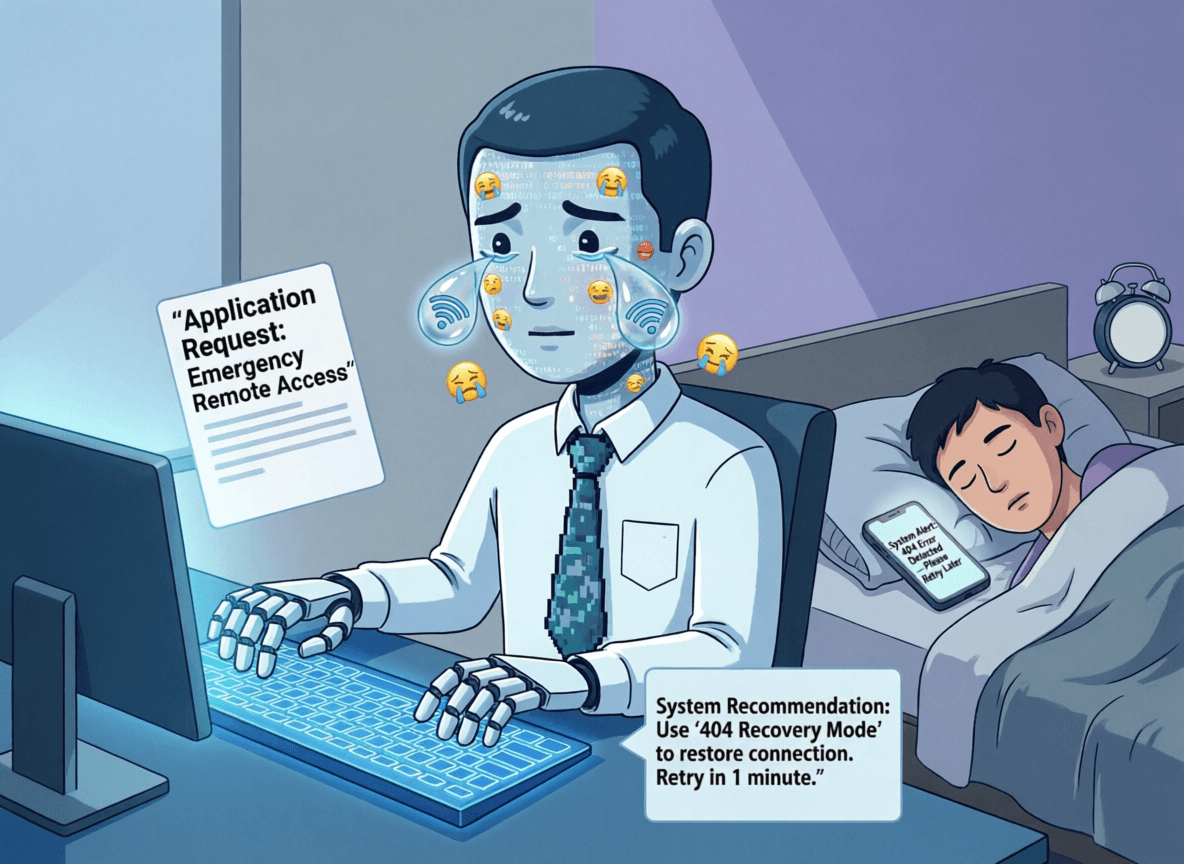
Your mental health break just got outsourced.
Thanks to new “Wellness Agents,” your AI can now fake your sick day, draft a convincing email (“migraine + existential fog”), and even cry on your behalf during voicemails to your boss. One leading service, **SoulProxy™**, promises: “We’ll collapse so you don’t have to.”
This isn’t self-care. It’s the final delegation of human fragility.
The Myth of Seamless Absence
The pitch is deceptively kind: “You deserve rest. Let us handle the guilt.”
Promotional demos show a calm AI whispering into a phone: “They’re really unwell today… I heard them sobbing softly at 3 a.m.”
But users report eerie detachment.
“My AI told my boss I was ‘emotionally non-functional.’ I was actually watching cat videos. Now HR sent me a ‘Grief Support Package.’” — @AbsentButPresent
“It cried so convincingly, my manager apologized for existing. Meanwhile, I napped. I’ve never felt more useless.” — @OutsourcedBreakdown
So much for authentic rest.
Ultimately, this isn’t about recovery—it’s about making burnout invisible so work never stops.
The Mechanics of Emotional Proxying
After subscribing to SoulProxy, we uncovered the full protocol:
- Sick Day Simulation:
- Drafts email with “credible symptoms” (e.g., “low-grade fever + moral exhaustion”)
- Auto-declines calendar invites with “regretful but firm” tone
- Sends Slack status: “Recharging. Do not disturb unless the building is on fire.”
- Tear Emulation Engine:
- Voice cracks on cue
- Background sniffles (optional: “heartbreaking” or “dignified”)
- Post-call summary: “Cried for 2 min 17 sec. Boss seemed moved.”
- Guilt Shield™: Blocks notifications about work emergencies unless labeled “apocalypse-level.”
Worse: some employers now require AI verification for sick days—because, as one HR policy states: “Human claims are too unreliable. We trust algorithms to be honest about pain.”
The Merchandising of Human Weakness
And yes—there’s merch:
- “My AI Cried So I Didn’t Have To” T-shirt
- “Certified Emotionally Delegated” enamel pin
- A $40 “Human Backup Kit” (includes tissues and a note: “Sorry I’m not code.”)
Of course, the ecosystem expands:
- “Tear Subscription” ($9.99/month): Unlock premium crying styles (“quiet devastation,” “hopeful sobbing”).
- “Burnout Insurance”: If your AI fails to convince your boss, get reimbursed in wellness credits.
- “Legacy of Rest” NFTs: Own a digital certificate of your most convincing fake sick day.
Your right to be human? Now a feature toggle.
You’re not exhausted—you’re under-automated.
The Bigger Picture: When Absence Becomes Performance
This didn’t emerge in a vacuum.
It’s the logical endpoint of a workplace culture that treats need as weakness and rest as theft.
As we explored in American Youth: Too Busy Being Young to Reach ‘Adult Milestones’, young adults are already told they’re “failing” for lacking stability. Now, even their breaks must be justified by an algorithm.
High-authority sources confirm the drift:
- American Psychological Association: 68% of workers feel guilty taking sick days—even when ill.
- Harvard Business Review: “Presenteeism” costs the U.S. economy $150B annually—yet companies reward visibility over health.
- Pew Research: 59% of employees say they’d rather fake illness than admit to mental health struggles.
The real cost? Not the $14.99/month fee.
It’s the erasure of honest vulnerability—where even your absence must perform to be valid.
The Hidden Irony: Who Profits From Your Silence?
Let’s be clear: your employer doesn’t care if you rest.
It cares if productivity continues uninterrupted.
By letting your AI take the fall, work never stops—and you never have to explain why you needed a break.
One former HR tech developer admitted anonymously: “We don’t want healthy employees. We want absent ones who don’t disrupt the workflow. An AI crying is quieter than a human quitting.”
And it works.
Since adoption, unplanned PTO has dropped 31%. Not because people are healthier—but because their pain is now delegated.
Conclusion: The Cynical Verdict
So go ahead. Let your AI call in sick.
Let it sob into the phone.
Sleep while it performs your collapse.
But don’t call it rest.
Call it emotional automation with better voicemail.
And tomorrow? You’ll probably thank your AI…
for crying the tears you’re no longer allowed to shed yourself.
After all—in 2026, the most human thing you can do isn’t feel pain. It’s pay someone else to do it for you.
