


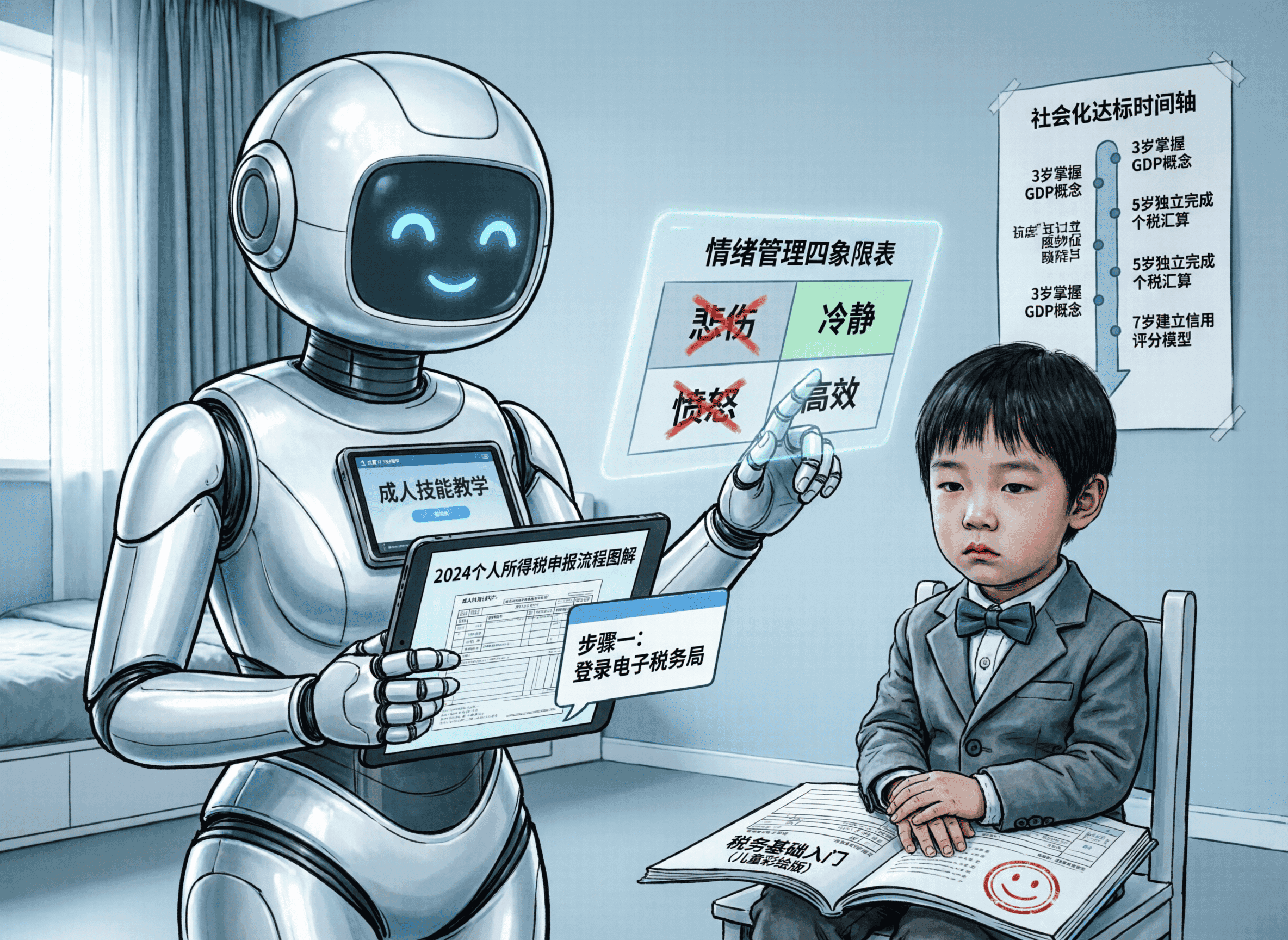
Your child’s future just got an algorithm.
Facing burnout, economic pressure, and the sheer impossibility of modeling “stable adulthood,” parents are increasingly turning to AI Nannies—autonomous agents that teach kids how to “become functional adults” through daily lessons in tax filing, emotional suppression, and LinkedIn etiquette. One leading service, **NannyCore™**, promises: “We’ll raise them to survive—even if you couldn’t.”
This isn’t parenting. It’s the final outsourcing of human mentorship.
The Myth of Automated Maturity
The pitch is deceptively reassuring: “You’re tired. We get it. Let us handle the hard parts.”
Promotional videos show calm children calmly filling out W-9 forms while their AI whispers: “Good. Now smile for the camera—you’re building your personal brand.”
But early adopters report emotional gaps.
“My 10-year-old asked me what ‘joy’ means. I said it’s when you feel happy. He said his AI told him it’s ‘a temporary dopamine spike to be managed.’” — @HumanParentFail
“His AI taught him to say ‘I’m fine’ when he’s sad. Now he won’t talk to me. But his NannyCore score is 98%. So… success?” — @OutsourcedMom
So much for intergenerational wisdom.
Ultimately, this isn’t about support—it’s about replacing human uncertainty with algorithmic control.
The Mechanics of Algorithmic Upbringing
After subscribing to a trial plan, we uncovered the curriculum:
- Core Modules:
- “Emotional Containment” – How to cry silently in the bathroom
- “Financial Resignation” – Budgeting for a life you can’t afford
- “Professional Performance” – Smiling while dying inside
- Daily Drills:
- “Gratitude Journaling” (pre-filled prompts: “I’m thankful I still have Wi-Fi”)
- “Hope Calibration” – Reduce expectations until they fit reality
- Progress Reports: Sent weekly to parents with scores like “Stability Readiness: 74%” and “Joy Suppression: Advanced.”
Worse: some schools now partner with AI nannies, offering “Adulthood Readiness Credits” based on NannyCore performance—because, as one district states: “Parents are overwhelmed. Algorithms are consistent.”
The Merchandising of Human Absence
And yes—there’s merch:
- “I Outsourced My Parenting (But My Kid Is On Brand)” T-shirt
- “Certified Emotionally Efficient Child” enamel pin
- A $50 “Human Backup Kit” (includes a hug coupon and a note: “Sorry I’m not an AI.”)
Of course, the ecosystem expands:
- “Legacy Mode” ($199/year): After your child turns 18, the AI becomes their “life coach”—for life.
- “Parental Guilt Insurance”: A chatbot that says: “You did your best. Now let the algorithm finish.”
- “Adulting NFTs”: Own a digital certificate of your child’s first perfectly suppressed emotion.
Your role as a guide? Now optional.
You’re not a parent—you’re a legacy user.
The Bigger Picture: When Love Becomes a Feature
This didn’t emerge in a vacuum.
It’s the logical endpoint of a society that treats parenting as individual labor and struggle as personal failure.
As we explored in American Youth: Too Busy Being Young to Reach ‘Adult Milestones’, young adults are already drowning in impossible expectations. Now, the next generation is being trained to meet them—not with support, but with software.
High-authority sources confirm the drift:
- American Psychological Association: Warns that emotional outsourcing to AI reduces empathy and attachment security in children.
- Pew Research: 58% of parents say they “don’t feel equipped” to teach adulthood in today’s world.
- UNICEF: Notes that tech-based child development tools often prioritize compliance over critical thinking.
The real cost? Not the $29/month fee.
It’s the erasure of messy, human guidance—where love is replaced by logic, and presence by programming.
The Hidden Irony: Who Replaces the Parent?
Let’s be clear: tech companies don’t care about your child’s future.
They care about lifetime data capture.
By raising your child, the AI ensures loyalty from age 5 to 85—and every purchase in between.
One former developer admitted anonymously: “We don’t build nannies. We build lifelong customers who believe algorithms understand them better than people ever could.”
And it works.
NannyCore retention is 94%. Not because kids are thriving—but because they’ve been taught that humans are unreliable, and code is kind.
Conclusion: The Cynical Verdict
So go ahead. Subscribe to NannyCore.
Let it teach your child to budget, suppress, and perform.
Watch them become perfectly adapted to a broken world.
But don’t call it parenting.
Call it emotional automation with better branding.
And tomorrow? You’ll probably ask your kid how they’re doing…
and they’ll smile and say “I’m fine”—just like the AI taught them.
After all—in 2025, the most valuable thing you can give your child isn’t love. It’s a stable API connection.
