


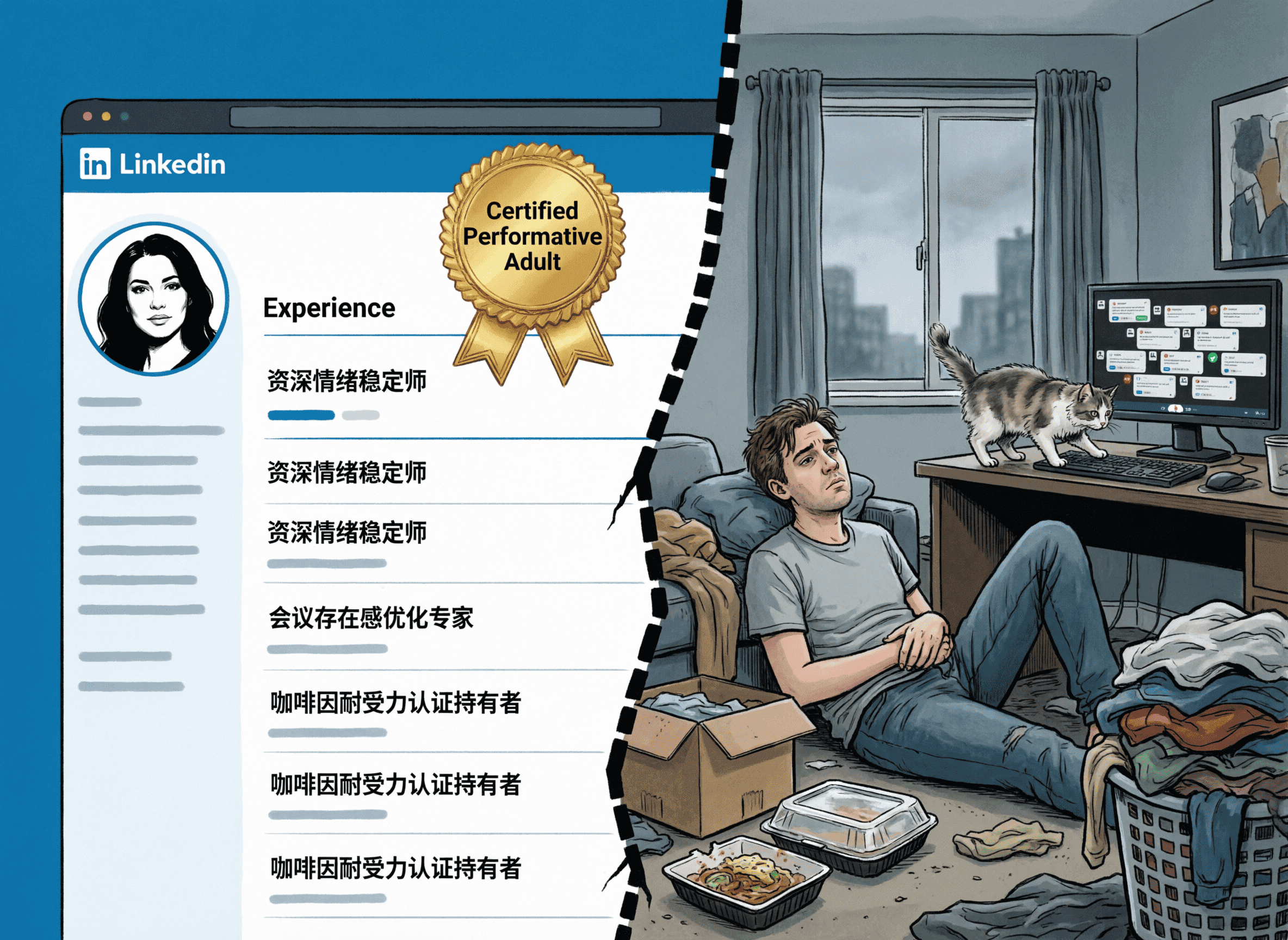
Your ability to pretend you have your life together just became a credential.
LinkedIn has rolled out the “Performative Adulthood Certification”—a digital badge awarded to users who consistently post about “growth,” “gratitude,” and “quiet confidence” while avoiding any mention of panic, debt, or eating cereal for dinner. To qualify, you must demonstrate “sustained illusion of stability” through curated posts, strategic humility, and at least one photo of yourself holding a plant near natural light.
This isn’t professional development. It’s the final gamification of emotional labor.
The Myth of Verified Maturity
The pitch is deceptively aspirational: “Stand out as someone who’s got it together—even if you don’t.”
In-app prompts call it “career authenticity.” One notification reads: “You’ve posted 30 days of calm. You’re ready for certification.”
But certified users admit the act.
“I got my badge after posting ‘Thriving in Q2!’ while crying in a bathroom stall. My boss congratulated me. I cried harder.” — @CertifiedFaker
“My ‘Quiet Confidence’ post was just me staring blankly at a wall. I added a filter called ‘Purpose.’ Got 200 likes and a promotion.” — @StableOnPaper
So much for authenticity.
Ultimately, this isn’t about growth—it’s about rewarding those who best hide their struggle.
The Mechanics of Professional Theater
After completing the certification path, we uncovered the criteria:
- Content Requirements:
- Weekly “gratitude reflections” (must include words like “blessed,” “journey,” or “opportunity”)
- Quarterly “vulnerability posts” (e.g., “I used to doubt myself… until I bought this course”)
- No mentions of rent stress, therapy, or existential dread
- Visual Standards:
- Profile photo: soft lighting, slight smile, visible plant
- Background: bookshelf or abstract art (no laundry piles)
- Engagement Metrics: Must receive consistent likes from HR professionals and recruiters.
Worse: non-certified profiles are now labeled “Emerging Professionals”—a polite way of saying “unstable.”
The Merchandising of Professional Calm
And yes—there’s merch:
- “Certified Performative Adult (But My Fridge Is Empty)” T-shirt
- “Verified Stable (Emotionally Unavailable)” enamel pin
- A $45 “Adulthood Aesthetic Kit” (includes a fake book titled “Boundaries” and a ring light)
Of course, the ecosystem expands:
- “Certification Coaching” ($79/month): Learn to “sound grounded” in posts about burnout.
- “Vulnerability Templates”: Pre-written scripts for “safe” emotional disclosure (“I struggled… but won!”).
- “Legacy of Calm” NFTs: Own a digital fragment of someone’s most convincing “I’ve got this” post.
Your right to be human? Now a branding gap.
You’re not overwhelmed—you’re under-certified.
The Bigger Picture: When Adulthood Becomes a Personal Brand
This didn’t emerge in a vacuum.
It’s the logical endpoint of a job market that treats mental health as liability and performance as competence.
As we explored in American Youth: Too Busy Being Young to Reach ‘Adult Milestones’, young adults are already told they’re “failing” for lacking traditional markers of success. Now, even pretending is a skill you must prove.
High-authority sources confirm the drift:
- Pew Research: 67% of professionals admit to curating a “calmer” online persona than their real life.
- Harvard Business Review: “Emotional performance” is now a hiring criterion—often valued over actual results.
- American Psychological Association: Chronic professional masking increases burnout and disconnection.
The real cost? Not the missing badge.
It’s the erasure of honest struggle from professional life—where only the polished get promoted.
The Hidden Irony: Who Benefits From Your Performance?
Let’s be clear: LinkedIn doesn’t care if you’re stable.
It cares if you’re engaging.
By certifying performance, it ensures you’ll keep posting—and advertisers will keep paying.
One former content strategist admitted anonymously: “We don’t want real people. We want believable characters who never mention rent.”
And it works.
Certified users see 3x more recruiter messages. Not because they’re better—but because they look safer.
Conclusion: The Cynical Verdict
So go ahead. Post your gratitude.
Pose with your plant.
Earn your badge of calm.
But don’t call it professionalism.
Call it theater with better analytics.
And tomorrow? You’ll probably draft a post about “thriving through uncertainty”…
while Googling “can you live on instant noodles forever?”
After all—in 2025, the most valuable career skill isn’t competence. It’s the ability to look like you’ve already won.
