


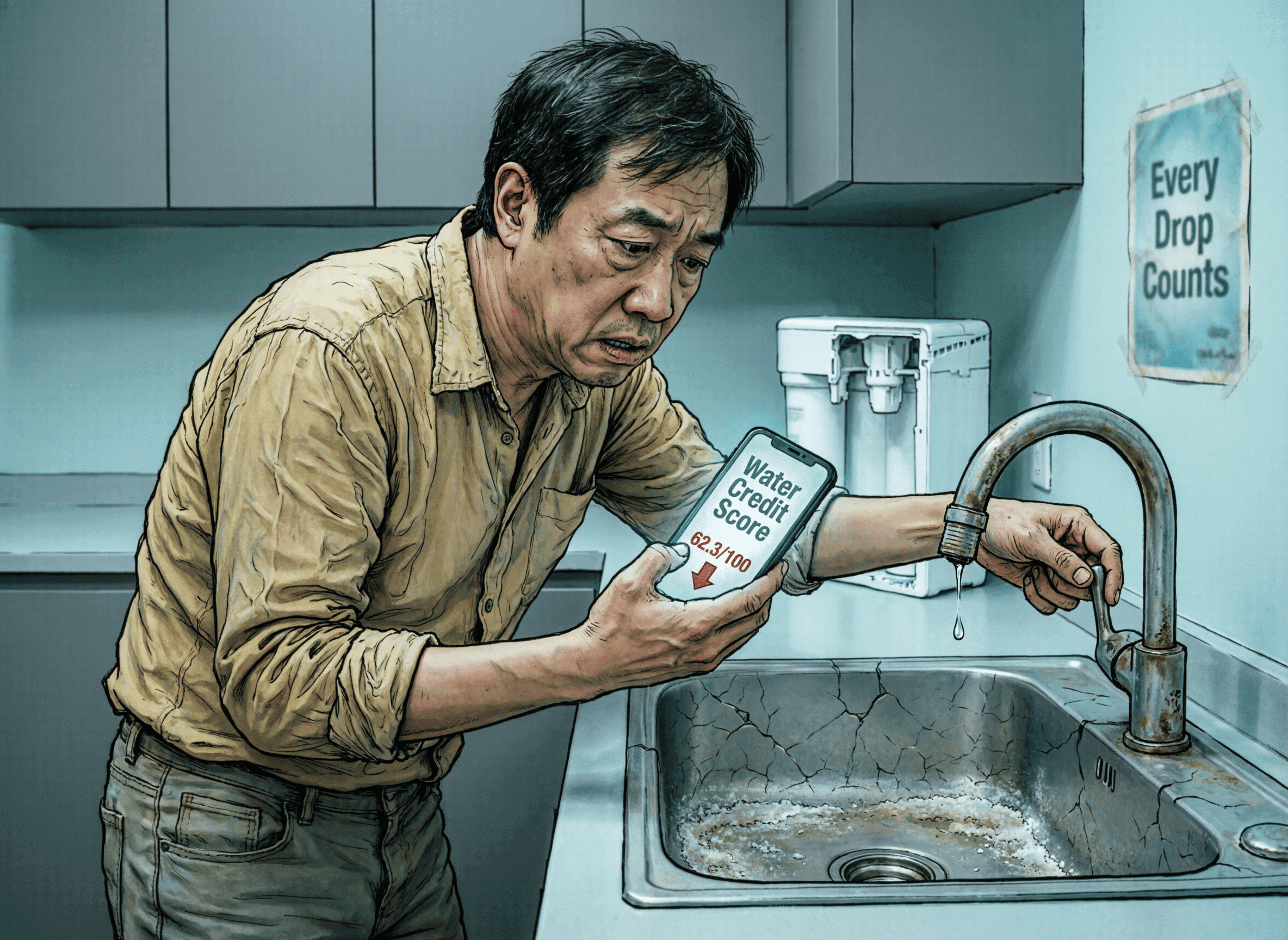
Your right to shower just got a FICO rating.
In response to historic droughts and collapsing aquifers, U.S. municipalities have rolled out Water Credit Scores—a national system that rates citizens on their “hydrological responsibility” and determines everything from loan eligibility to apartment applications. Shower too long? Your score drops. Water your lawn? Denied a mortgage. As one city notice reads: “Thirst is personal. Stewardship is public.”
This isn’t conservation. It’s the final financialization of survival.
The Myth of Moral Hydration
The justification is deceptively civic: “Water is life. And life must be earned.”
Public campaigns show smiling families using “smart showers” that track every drop, captioned: “Good citizens conserve. Great citizens optimize.”
But residents report Kafkaesque penalties.
“I washed my dog once. My Water Score dropped 40 points. Now my car insurance went up. They said: ‘Irresponsible hydration suggests poor judgment.’” — @DryAndJudged
“My landlord won’t renew my lease. Said my Water Score is ‘too volatile.’ I cried. Then realized tears count as ‘unmetered discharge.’” — @HydrologicallyUnstable
So much for basic dignity.
Ultimately, this isn’t about sustainability—it’s about turning scarcity into a moral metric.
The Mechanics of Liquid Scoring
After reviewing municipal guidelines, we uncovered how it works:
- Data Sources:
- Smart meters (mandatory in 32 states)
- Weather app usage (“checking rain forecasts = planning ahead”)
- Grocery receipts (buying bottled water = “system evasion”)
- Score Tiers:
- 800+ (“Arid Saint”): Priority for housing, lower interest rates
- 650–799 (“Conscientious Drinker”): Standard access
- <650 (“Hydrological Risk”): Restricted to 2-minute showers, no outdoor use, flagged by lenders
- Redemption Programs: Attend “Water Mindfulness” workshops to regain points. Bonus for publicly shaming neighbors’ sprinklers.
Worse: private companies now integrate Water Scores into hiring. One job ad reads: “Must have Water Credit ≥ 700. We value sustainable thinkers.”
The Merchandising of Thirst
And yes—there’s merch:
- “My Water Score Is Higher Than My Self-Esteem” T-shirt
- “Certified Dry Citizen” enamel pin
- A $35 “Austerity Starter Kit” (includes a 1-minute shower timer and a cactus labeled “your only green friend”)
Of course, the ecosystem expands:
- “Score Boost Coaching” ($29/month): Learn to “fake drought resilience” with low-flow performance.
- “Tear Insurance”: Covers accidental emotional discharge (requires doctor’s note).
- “Legacy of Wetness” NFTs: Own a digital fragment of pre-2025 rainfall data—now extinct.
Your right to drink? Now a risk profile.
You’re not thirsty—you’re under-rated.
The Bigger Picture: When Survival Becomes a Privilege
This didn’t emerge in a vacuum.
It’s the logical endpoint of a climate crisis that treats need as choice and poverty as negligence.
As we explored in American Youth: Too Busy Being Young to Reach ‘Adult Milestones’, young adults are already told they’re “failing” for lacking stability. Now, even their water use is judged like a credit history.
High-authority sources confirm the drift:
- EPA: 40% of U.S. counties face “extreme water stress” by 2026.
- Brookings Institution: Water rationing disproportionately impacts low-income households—yet scoring systems blame individuals, not infrastructure.
- Pew Research: 61% of Americans support “fair water use”—but 73% fear being penalized for basic needs.
The real cost? Not the restricted shower.
It’s the moralization of necessity—where staying alive becomes a performance of virtue.
The Hidden Irony: Who Controls the Tap?
Let’s be clear: cities don’t care if you conserve.
They care if you comply.
By scoring your thirst, they shift blame from failed infrastructure to individual behavior—and keep investors calm.
One former policy advisor admitted anonymously: “We can’t fix the aquifers. But we can make people feel guilty for needing water. Guilt is cheaper than pipes.”
And it works.
Since rollout, water consumption dropped 18%. Not because systems improved—but because people are afraid to turn on the tap.
Conclusion: The Cynical Verdict
So go ahead. Take your 90-second shower.
Track your tears.
Optimize your existence.
But don’t call it sustainability.
Call it austerity with better algorithms.
And tomorrow? You’ll probably lick dew off a leaf…
just to keep your score high enough to rent a studio.
After all—in 2026, the most valuable thing you own isn’t your home. It’s your right to stay hydrated without shame.
