


Your right to shelter just got abstract.
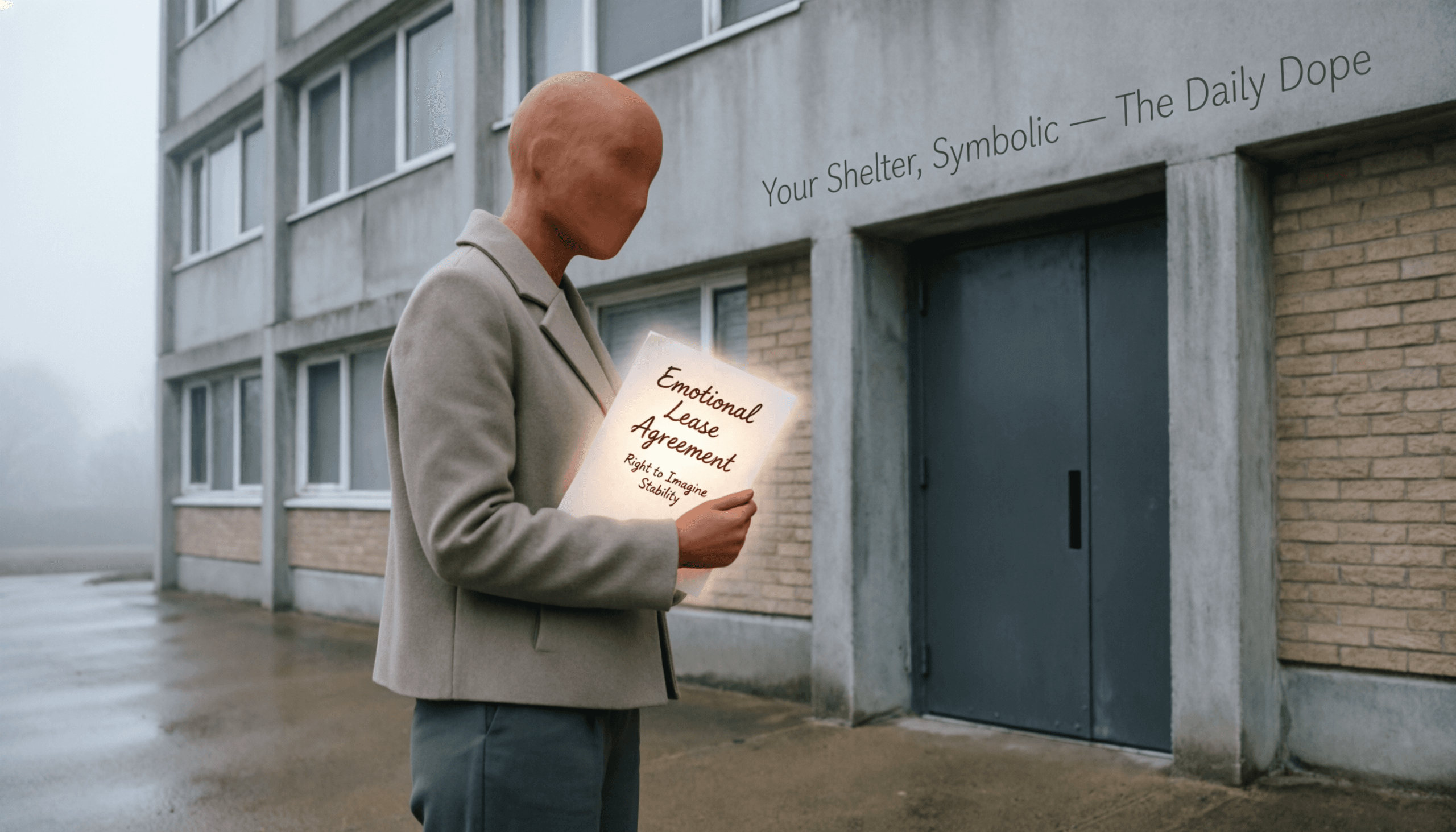
In cities where rent consumes 80% of income and waitlists for affordable housing stretch into decades, a new trend has emerged: landlords now sell “Emotional Lease Agreements”—legal documents that grant tenants the “right to imagine stability” without providing actual shelter. For $99/month, you receive a beautifully designed PDF titled “You Belong Here (In Spirit),” access to a private Slack channel called “Future Neighbors,” and a monthly affirmation: “Your dream apartment is manifesting.”
This isn’t housing. It’s the final financialization of belonging.
The Myth of Symbolic Shelter
The pitch is deceptively soothing: “When physical space is scarce, emotional space is everything.”
Promotional materials feature serene illustrations of people meditating in empty lots, captioned: “Home is a feeling—not a square footage.”
But renters see through the illusion.
“I’ve paid $99/month for 14 months. Got a ‘Stability Aura’ meditation and a digital keychain. Still sleep on my cousin’s couch. But hey—I’m ‘emotionally housed.’” — @SpirituallySheltered
“My Emotional Lease includes ‘priority manifestation status.’ I asked what that means. They said: ‘It means you’re first in line… in the universe.’” — @ManifestingRent
So much for four walls and a roof.
Ultimately, this isn’t about community—it’s about monetizing the gap between need and reality.
The Mechanics of Imaginary Tenancy
After purchasing a 3-month Emotional Lease, we uncovered the full offering:
- Core Benefits:
- Digital “Lease Certificate” with your name and a fictional address (“777 Serenity Blvd, Unit: Hope”)
- Monthly “Housing Affirmation” audio track (“You are worthy of shelter”)
- Access to “Community Vision Board” (a Pinterest board of unaffordable apartments)
- Premium Tiers:
- Basic ($99/month): Right to imagine stability
- Plus ($199/month): Adds “dream walkthrough” VR tour of a non-existent unit
- Elite ($499/month): Includes a physical “key to your future home” (brass-plated, non-functional)
Worse: some landlords now require an Emotional Lease as a **prerequisite** to joining real housing waitlists—because, as one property group states: “We want tenants who are emotionally ready for stability—even if we can’t provide it.”
The Merchandising of Displacement
And yes—there’s merch:
- “I’m Emotionally Housed (Physically Homeless)” T-shirt
- “Certified Future Resident” enamel pin
- A $35 “Shelter Simulation Kit” (includes a blanket labeled “walls” and a nightlight called “security”)
Of course, the ecosystem expands:
- “Manifestation Coaching” ($49/month): Learn to “vibe higher” so your apartment appears faster.
- “Lease Insurance”: Protect your emotional tenancy if you accidentally acknowledge reality.
- “Legacy of Shelter” NFTs: Own a digital deed to a home that existed only in someone’s 2020 vision board.
Your right to shelter? Now a subscription to hope.
You’re not unhoused—you’re pre-housed in the metaphysical sense.
The Bigger Picture: When Housing Becomes a Mood
This didn’t emerge in a vacuum.
It’s the logical endpoint of a housing market that treats shelter as luxury and need as weakness.
As we explored in American Youth: Too Busy Being Young to Reach ‘Adult Milestones’, young adults are already told they’re “failing” for not owning homes—despite median rents outpacing wages by 300% in major cities.
High-authority sources confirm the drift:
- U.S. Department of Housing and Urban Development: Over 500,000 Americans are homeless; 11 million spend more than half their income on rent.
- Pew Research: 63% of adults under 35 believe they’ll never own a home.
- Brookings Institution: “Housing insecurity” is now a leading cause of anxiety among young adults.
The real cost? Not the $99 fee.
It’s the commodification of basic human need—where even the idea of home becomes a product you must pay to feel worthy of.
The Hidden Irony: Who Profits From Your Longing?
Let’s be clear: landlords don’t care if you have a roof.
They care if you keep paying.
By selling you the feeling of belonging, they ensure you stay compliant—even as you sleep on a floor.
One former property manager admitted anonymously: “We can’t build more units. But we can sell the dream of one. And dreams don’t demand repairs.”
And it works.
Emotional Lease revenue has grown 300% in 2025. Not because people are housed—but because they’re desperate to believe they might be someday.
Conclusion: The Cynical Verdict
So go ahead. Sign your Emotional Lease.
Visualize your kitchen.
Hold your non-functional key like a talisman.
But don’t call it housing.
Call it capitalism with better affirmations.
And tomorrow? You’ll probably meditate on your “future balcony”…
while wondering if your cousin will mind you staying another month.
After all—in 2025, the most expensive thing you’ll ever rent isn’t an apartment. It’s the belief that you deserve one.
